Skip to content
GardenPrimer

Best Organic Fertilizers & Soil Amendments

Granular and liquid organic feeds, compared on N-P-K honesty, OMRI listing, and true cost per application.

Organic fertilizer is a repeat purchase, so we compare it like one: cost per application, not sticker price. We look at whether the N-P-K numbers fit the job, whether the product carries a real OMRI listing, how it smells and handles, and how the granular workhorses compare to fish and kelp liquids for quick feeding.

5 models scored · Research checked November 17, 2026

Organic Fertilizers & Soil Amendments

New to this? Fertilizers belong to Level 2 of the Primer Path — Your First Bed. Learn the skill first, then buy once.

Read the level →

Our picks, in recommended order

The order is our editorial call on overall fit — price, size, setup and the drawbacks you'll live with. The PrimerScore summarizes public owner-rating signals, so the two can disagree. Filter by what matters to you.

We may earn a commission from qualifying Amazon purchases, at no extra cost to you. How affiliate links work.

Showing all 5 picks

Pick 1
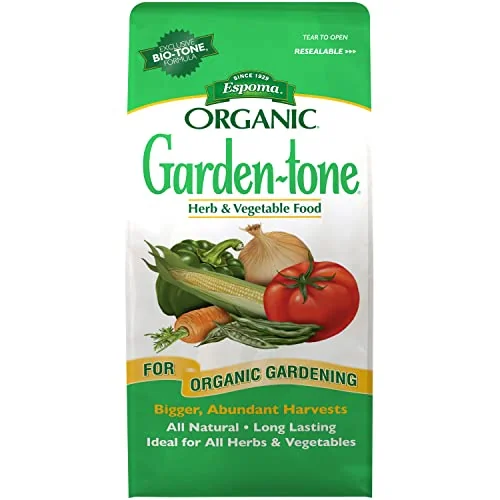
Garden-tone Organic Herb & Vegetable Food 3-4-4, 4 lb

The default granular feed for vegetable beds — a gentle 3-4-4 blend with added beneficial microbes and decades of track record, applied monthly through the season.

Picked for: Vegetable beds · OMRI listed

✓ Gentle 3-4-4 blend that's hard to overdo✕ Noticeable manure-and-meal smell for a day or two
PrimerScore 84Check priceFull review →
Our research on the Espoma Garden-tone Organic Herb & Vegetable Food 3-4-4, 4 lb

The default granular feed for a vegetable bed. Garden-tone is a mild 3-4-4 blend that Espoma enhances with humates and beneficial microbes, with no sludges or fillers. The label is beginner-friendly: work 3 lb per 50 sq ft into the top 4–5 inches when preparing a bed, start feeding transplants 7–10 days after planting, then feed established plants monthly from May through August, up to 1/3 cup per tomato plant. The trade-off is cost: the Jobe's 4-4-4 bag costs the same with slightly higher analysis, and the 4 lb bag only covers a small bed.

Best for
New vegetable and herb gardeners who want a gentle, clearly labeled monthly feed for beds and containers.
Skip it if
You want an OMRI-listed bag with a wider ingredient list; the Down To Earth 4-6-2 lists every source.
  • Gentle 3-4-4 blend that's hard to overdo
  • Includes beneficial soil microbes (Bio-tone)
  • Long-established brand with clear label rates
  • Noticeable manure-and-meal smell for a day or two
  • Costs more per pound than basic blends
N-P-K3-4-4
FormGranular
Size4 lb bag
Feeding intervalMonthly per label
Application rate3 lb per 50 sq ft (new beds)
Other sizes8, 18 and 36 lb bags
Derived fromNatural blend with humates, microbes

Sources

Research checked Nov 17, 2026. We research picks; we don't test them.
Pick 2
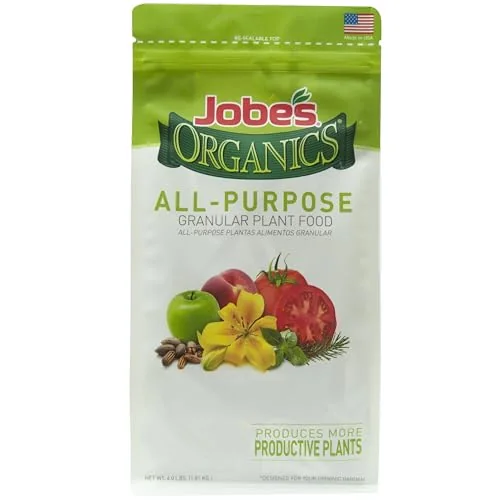
Organics All-Purpose Granular Fertilizer 4-4-4, 4 lb

The value granular: a balanced 4-4-4 OMRI-listed blend with Jobe's microbe package, at the lowest cost per feeding of our picks for beds and containers alike.

Picked for: Best value · Vegetable beds · OMRI listed

✓ Lowest cost per application here✕ Smell attracts curious dogs — water it in
Our research on the Jobe's Organics All-Purpose Granular Fertilizer 4-4-4, 4 lb

The value granular. Jobe's 4-4-4 is a balanced all-purpose blend with Jobe's Biozome, a mix of bacteria, mycorrhizal fungi and archaea that the maker says break down organic matter into nutrients plants can absorb. It is described as OMRI and USDA approved for organic crop production and made in the USA. It matches Garden-tone's price with a slightly higher analysis, and the balanced ratio suits beds, containers and shrubs alike. The trade-off: it is a generalist, without the vegetable-specific rate chart Garden-tone and Down To Earth print.

Best for
Budget-minded gardeners who want one balanced organic granular for vegetables, flowers and containers.
Skip it if
You want a fast liquid boost for seedlings; Neptune's Harvest or Alaska fish fertilizer fits that job.
  • Lowest cost per application here
  • Balanced 4-4-4 works nearly everywhere
  • OMRI listed with a resealable bag
  • Smell attracts curious dogs — water it in
  • Coarse texture is slower to break down in cool soil
N-P-K4-4-4
FormGranular
Size4 lb bag
Feeding intervalEvery 8 weeks per label
Application rateAt planting, then every 8 weeks
OMRI listedYes, per retailer listing
Derived fromOrganic blend with Biozome microbes

Sources

Research checked Nov 17, 2026. We research picks; we don't test them.
Pick 3
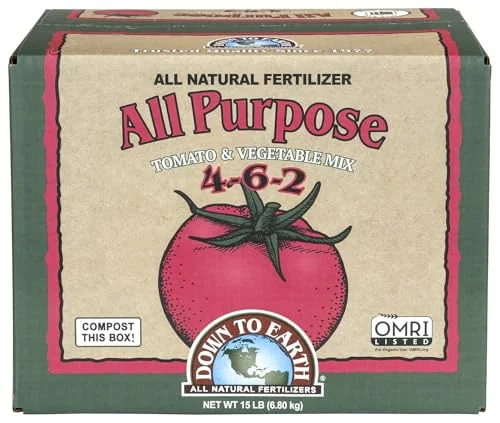
All Purpose Mix 4-6-2, 15 lb Box

The enthusiast's blend: a stronger 4-6-2 mix of feather meal, fish bone meal, and kelp in a compostable box, OMRI listed and measured out by the scoop.

Picked for: Vegetable beds · OMRI listed

✓ Rich ingredient list — feather meal, fish bone meal, kelp✕ Priciest per pound of our picks
Our research on the Down To Earth All Purpose Mix 4-6-2, 15 lb Box

The pick with the most transparent ingredient list. Down To Earth's 4-6-2 is derived from fish bone meal, blood meal, feather meal, alfalfa meal, rock phosphate, langbeinite and seaweed meal, adds 8% calcium plus magnesium and sulfur, and is OMRI listed. Its label gives rates for almost every use: 2.5–5 lb per 100 sq ft for new beds, 1–2 tablespoons per transplant hole, and a monthly side-dress for established plants. The trade-offs: the 15 lb box is the biggest outlay here, and the extra phosphorus is not needed in every soil, so a soil test helps.

Best for
Committed vegetable gardeners who want an OMRI-listed blend with known ingredients and detailed label rates.
Skip it if
You only have a few containers; the 4 lb Jobe's or Espoma bag costs far less up front.
  • Rich ingredient list — feather meal, fish bone meal, kelp
  • OMRI listed with transparent sourcing
  • Compostable fiberboard box, no plastic bag
  • Priciest per pound of our picks
  • Higher phosphorus than some soils need — soil test first
N-P-K4-6-2
FormGranular
Size15 lb box
Feeding intervalMonthly per maker
Application rate2.5–5 lb per 100 sq ft (new beds)
OMRI listedYes
Derived fromFish bone, blood, feather, alfalfa meal
Other sizes1, 5 lb boxes; 25, 40 lb bags

Sources

Research checked Nov 17, 2026. We research picks; we don't test them.

Pick 4
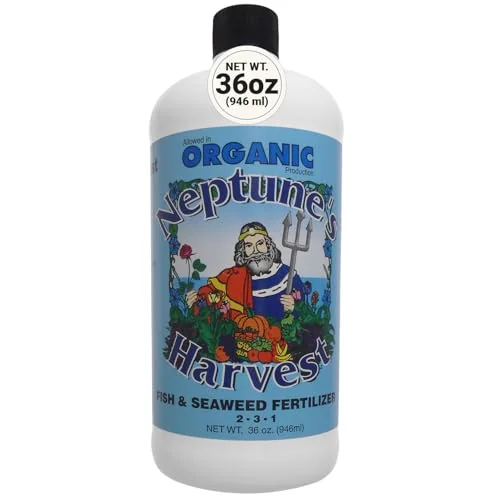
Fish & Seaweed Fertilizer 2-3-1, 36 oz

The liquid top-up: a hydrolyzed fish and kelp concentrate you dilute and water in every week or two for transplants, seedlings, and mid-season boosts between granular feedings.

Picked for: Liquid feeding · Vegetable beds

✓ Fast-acting complement to granular base feeding✕ Strong fish smell during application
Our research on the Neptune's Harvest Fish & Seaweed Fertilizer 2-3-1, 36 oz

The liquid top-up between granular feedings. Neptune's Harvest blends hydrolyzed fish with seaweed into a 2-3-1 concentrate that is OMRI listed for organic use. Because it is mixed into water, it reaches roots right away, which suits transplants and seedlings that granular food would reach slowly. The company rates a quart to make up to 32 gallons and a gallon up to 128, about an ounce of concentrate per gallon of water. The trade-offs are the fish smell and the need to repeat it often, since a liquid feed does not linger in the soil like granules.

Best for
Gardeners who want a gentle, organic liquid feed for seedlings, transplants and mid-season boosts.
Skip it if
You want the most nitrogen for leafy crops per dollar; the Alaska 5-1-1 gallon costs less per mix.
  • Fast-acting complement to granular base feeding
  • A 36 oz bottle dilutes into many gallons
  • Hydrolyzed (not emulsified) — retains more oils and proteins
  • Strong fish smell during application
  • Needs reapplying every 1–2 weeks
N-P-K2-3-1
FormLiquid concentrate
Size36 oz bottle
Feeding intervalEvery 1–2 weeks per label
Application rateAbout 1 oz per gallon of water
OMRI listedYes
Derived fromHydrolyzed fish and seaweed
Other sizesQuart, gallon, 5-gallon pail

Sources

Research checked Nov 17, 2026. We research picks; we don't test them.

Pick 5
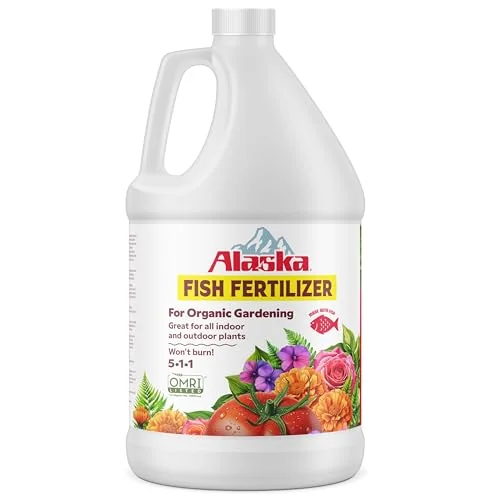
Fish Emulsion Fertilizer 5-1-1, 1 Gallon

The classic gallon of fish emulsion — a nitrogen-forward 5-1-1 liquid that costs pennies per diluted gallon, ideal for greening up leafy crops and lawns organically.

Picked for: Liquid feeding · Best value

✓ Cheapest liquid feeding per gallon diluted✕ The smelliest product in this lineup
Our research on the Alaska Fish Emulsion Fertilizer 5-1-1, 1 Gallon

The cheapest way to feed with liquid. Alaska's 5-1-1 is derived from fish solubles, and its nitrogen-heavy ratio is aimed at green, leafy growth. The label mixes 2 tablespoons per gallon of water for vegetables, bedding plants and annuals, enough for 25 sq ft of soil, so a full gallon jug goes a long way, and it says to apply every three weeks in the growing season. Pennington describes it as OMRI listed and says it won't burn. The trade-offs: a strong fish smell, and the low phosphorus and potassium make it a poor main food for fruiting plants.

Best for
Gardeners feeding lettuce, greens, herbs and young plants who want a low-cost organic liquid.
Skip it if
You feed fruiting crops like tomatoes; Neptune's Harvest 2-3-1 or a granular such as Garden-tone is more balanced.
  • Cheapest liquid feeding per gallon diluted
  • Nitrogen-forward — great for leafy greens
  • Decades-old formula, widely stocked
  • The smelliest product in this lineup
  • Too nitrogen-heavy for fruiting-stage tomatoes
N-P-K5-1-1
FormLiquid concentrate
Size1 gallon jug
Feeding intervalEvery 3 weeks per label
Application rate2 Tbsp per gallon of water (vegetables)
OMRI listedYes
Derived fromFish solubles, phosphoric acid
Other sizes32 oz, 5 gallon

Sources

Research checked Nov 17, 2026. We research picks; we don't test them.

Comparison of every fertilizers pick
Pick
Espoma Garden-tone Organic Herb & Vegetable Food 3-4-4, 4 lb#1
Mid-rangeEspoma Garden-tone Organic Herb & Vegetable Food 3-4-4, 4 lb
Jobe's Organics All-Purpose Granular Fertilizer 4-4-4, 4 lb#2
BudgetJobe's Organics All-Purpose Granular Fertilizer 4-4-4, 4 lb
Down To Earth All Purpose Mix 4-6-2, 15 lb Box#3
PremiumDown To Earth All Purpose Mix 4-6-2, 15 lb Box
Neptune's Harvest Fish & Seaweed Fertilizer 2-3-1, 36 oz#4
Mid-rangeNeptune's Harvest Fish & Seaweed Fertilizer 2-3-1, 36 oz
Alaska Fish Emulsion Fertilizer 5-1-1, 1 Gallon#5
BudgetAlaska Fish Emulsion Fertilizer 5-1-1, 1 Gallon
Price & buy

Check price

Check price on Amazon

$13.99

Check price on Amazon

$48.99

Check price on Amazon

$22.49

Check price on Amazon

$26.97

Check price on Amazon

Prices checked Oct 10, 2026 and change often. Specs are as the manufacturers state them. We may earn a commission from qualifying Amazon purchases.

How to choose fertilizers

Read the three numbers, not the brand name

The N-P-K on every bag lists nitrogen, phosphorus, and potassium by percent. Leafy growth leans on nitrogen; roots, fruit, and flowers lean on the other two. Organic blends run low numbers — 3-4-4 is normal, not weak — because they release slowly as soil life breaks them down.

Price the application, not the bag

Fertilizer is a consumable, so divide bag price by the square footage the label says it covers. A cheaper bag with a heavier application rate often costs more per feeding. Granulars are your base feed every month or two; fish and kelp liquids are the quick top-up between.

OMRI listing is the signal that means something

Anyone can print the word organic on a bag. An OMRI listing means the Organic Materials Review Institute reviewed the product against USDA National Organic Program standards. If you grow food and the organic part matters to you, look for the OMRI seal and follow the label rates — more is not better.

Common questions

Why are organic N-P-K numbers so much lower than synthetic ones?

Organic nutrients are bound up in things like feather meal and bone meal, and soil microbes release them gradually. The label reports what's immediately claimable, so 3-4-4 organic feeds steadily for weeks where a 24-8-16 synthetic delivers a fast, short spike.

Granular or liquid — which should I buy first?

Start granular. A slow-release all-purpose like a 3-4-4 or 4-4-4 worked into the bed covers most needs for a month or two per application. Add a fish or kelp liquid later for transplants and quick mid-season pick-me-ups — they act faster but need reapplying every week or two.

Is more fertilizer ever better?

No — follow the label rate. Overfeeding wastes money, can burn plants even with organics, and excess nutrients wash into waterways. If plants look hungry at the labeled rate, the smarter next step is a soil test through your county extension office, not a heavier hand.