Tomato Blossom End Rot: Why Eggshells Won't Fix It
5 min readPublished Primer Path Level 3
Researched and written by the GardenPrimer editorial team · How we research
The quick answer
Blossom end rot is the black sunken patch on a tomato's bottom, caused by calcium failing to reach the fruit during rapid growth. Uneven watering, not low soil calcium, is almost always the reason. Steady moisture from drip irrigation plus mulch fixes it; eggshells and calcium sprays do not.
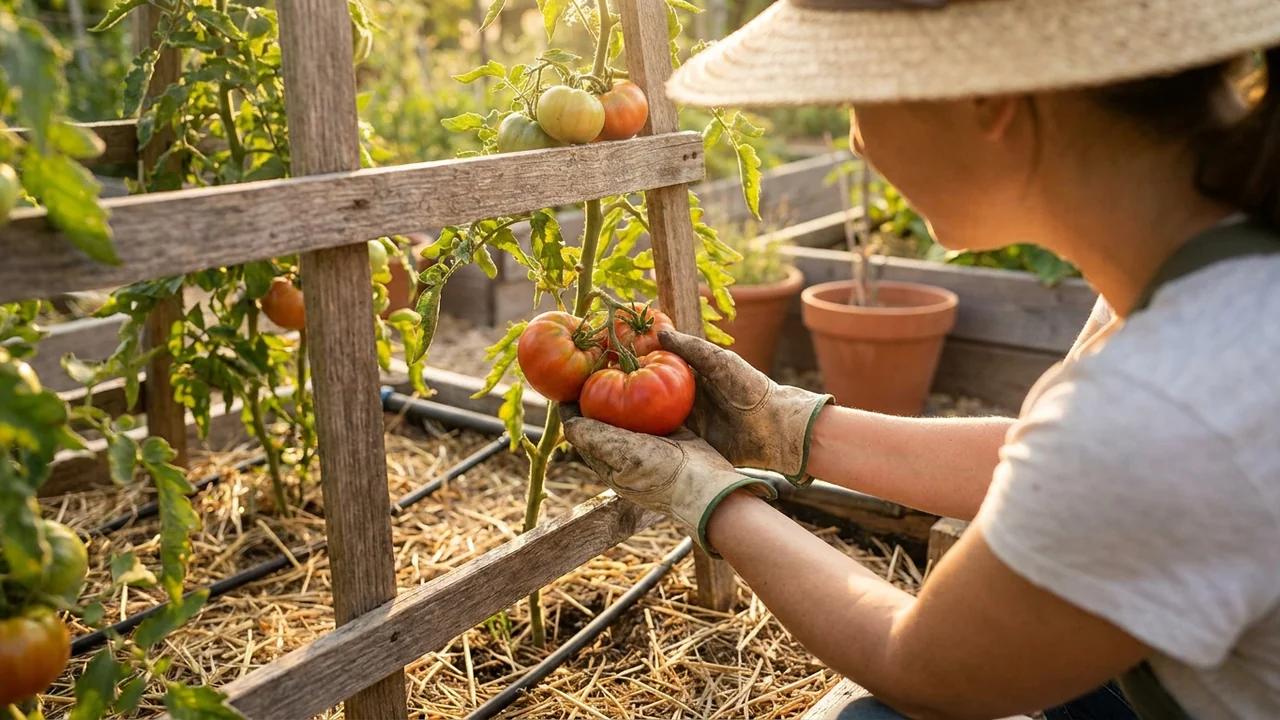
You water, you weed, you wait all summer, and then the first big tomato comes off the vine with a flat brown leathery crater on the bottom. That is blossom end rot, and almost everything the internet will tell you to do about it, mainly eggshells and calcium sprays, aims at the wrong target. The calcium is usually already in your soil. What is failing is the delivery system, and the delivery system is water.
What you are actually looking at
| What you see | What it means |
|---|---|
| Small water-soaked tan spot on the blossom end (bottom) | Earliest stage, often on the first fruits of the season |
| Flat, sunken, leathery brown-black patch | Classic blossom end rot, tissue collapsed and dried |
| Damage only on the bottom, never the shoulders | Confirms blossom end rot rather than sunscald or rot |
| Firm and dry rather than soft and oozing | Blossom end rot is not an infection, though molds can move in later |
| Sunken tan patch on the sun-facing side | Sunscald instead, caused by heat and lost leaf cover |
| Dark concentric rings around the stem end | Early blight or anthracnose, a fungal problem, not this |
The bottom of a young fruit is the last stop on the plant's plumbing. When calcium supply to that spot stutters even briefly during rapid cell division, the cell walls there fail and collapse. It happens in the fruit's first couple of weeks, which is why the damage appears on tomatoes that looked perfect the day before.
Peppers, eggplant, summer squash, and watermelon get blossom end rot too, by the same mechanism. The fix is identical.
The honest cause: delivery, not deficiency
Calcium moves through a plant in the water stream, and it does not get redistributed once it lands. That has two consequences most advice ignores: the plant cannot move calcium from a leaf to a fruit later, and if the water flow stalls, the newest fruit is the first thing cut off.
| Driver | What it does |
|---|---|
| Swing between bone-dry and soaked | The single biggest cause; interrupts the calcium stream at the worst moment |
| Heavy nitrogen feeding | Pushes leafy growth that outcompetes fruit for the water stream |
| Root damage from deep cultivation | Fewer working roots means less uptake, even in moist soil |
| Very fast growth in a heat spike | Leaves transpire hard and win the competition against fruit |
| Small containers | Dry out in hours, so swings are unavoidable without frequent watering |
| Genuinely low-calcium or very acidic soil | Real, but far less common than the four rows above |
That last row is why a soil test is worth doing once rather than guessing forever. Most garden soils in the United States hold plenty of calcium; the University of Minnesota Extension yard and garden resource hub is a reasonable starting point for finding a local testing lab.
Why eggshells and calcium sprays disappoint
- Eggshells break down far too slowly. Crushed shell is essentially rock. Whatever calcium it eventually releases arrives seasons after the fruit that needed it. Put them in the pile instead, where they are genuinely useful; see /blog/composting-for-beginners and our scored /category/composters.
- Foliar calcium sprays land on leaves, not fruit. Calcium barely moves once absorbed, so a leaf spray does not reach the fruit that is failing.
- Powdered milk, antacid tablets, and gypsum all add calcium to a soil that generally is not short of it.
- Lime is a pH tool, not a rescue. It is worth applying if a soil test shows a genuinely acidic soil, and pointless otherwise, and it acts far too slowly to save this season's fruit.
If a product promises to cure blossom end rot in days, it is selling you calcium for a problem that is not a calcium shortage.
What actually works
Steady soil moisture is the whole answer. Not more water, steadier water.
- Water on a schedule, deeply, not on a whim. Aim for the soil to stay evenly damp rather than cycling from soaked to cracked. Our watering-frequency guide, /blog/how-often-to-water-a-vegetable-garden, sets the baseline.
- Put down drip and a timer. This removes human inconsistency, which is the actual failure point. Size the run with the /tools/drip-calculator, then see /blog/drip-irrigation-for-raised-beds and the scored kits at /category/drip-irrigation-kits.
- Mulch two to three inches deep. Mulch is what turns a daily soak into an even week. Straw, shredded leaves, or arborist chips all work; details in /blog/mulching-guide.
- Ease off the nitrogen. A balanced feed beats a lawn-style high-nitrogen product here. /blog/npk-numbers-explained covers reading the bag, and steadier options sit at /category/organic-fertilizers.
- Stop cultivating near the stem. Pull weeds by hand within a foot of the plant instead of hoeing through the root zone.
- Size up containers. A tomato in a five-gallon pot swings twice a day in July. Ten gallons or more, mulched, is a different plant.
- Pick the damaged fruit off. It will not heal, and removing it lets the plant put its resources into the next set.
What to expect after you fix it
Existing damaged fruit stays damaged. What changes is the next wave.
- The first fruits of the season are the most commonly affected, even in well-run gardens, and later trusses often come through clean on their own.
- Paste and plum types, such as Roma and San Marzano, are noticeably more prone to it than round slicers.
- A run of heat or heavy rain after a dry spell can restart it, which is exactly why a timer beats memory.
- If every fruit on every plant is affected all season, that is when a soil test earns its keep.
Where this fits on the Primer Path
Blossom end rot is a watering-consistency problem wearing a disease costume, which puts it squarely in /path/steady-garden, the level about building systems that keep working when you are busy or away. Pest and disease diagnosis proper comes next at /path/feed-and-defend. And if you are still deciding when to set plants out, /blog/when-to-plant-tomatoes and the /tools/planting-calendar will get the season started on the right foot.
Common questions
Is blossom end rot contagious?+
No. It is a physiological disorder, not a fungus or bacteria, so it does not spread from fruit to fruit or plant to plant. Several plants often show it at once simply because they all experienced the same dry spell or heat spike.
Can I still eat a tomato with blossom end rot?+
Yes, if you cut away the affected area and the rest is firm and sound. The damaged tissue is dead, not toxic. Once secondary molds have moved into the sunken patch and the fruit has gone soft, compost it instead.
Do eggshells prevent blossom end rot?+
Not on any useful timescale. Crushed shell breaks down extremely slowly, so the calcium arrives long after the fruit that needed it. Eggshells are still worth composting for general soil health, but they are not a treatment for this problem.
Why do only my first tomatoes get it?+
Early fruit sets while the root system is still small and the weather is still swinging, so the plant struggles to keep water and calcium moving steadily. As roots fill in and your watering routine settles, later fruit usually comes through clean.