When to Plant Tomatoes: A Frost-Date Guide That Works
5 min readPublished Primer Path Level 2
Researched and written by the GardenPrimer editorial team · How we research
The quick answer
Set tomato transplants out about two weeks after your average last spring frost, once soil four inches down holds at 60°F or warmer and nights stay above the 40s. Start seeds indoors six to eight weeks before that transplant date, and add a week for hardening off.
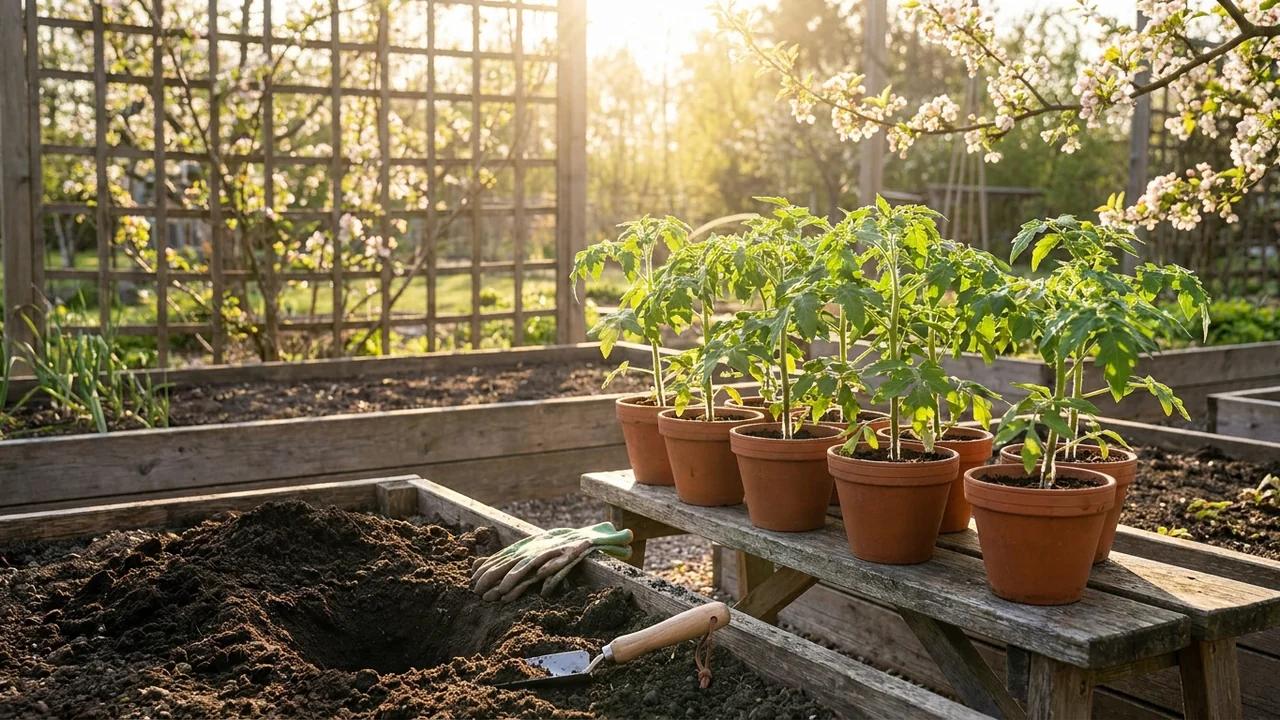
Every "plant tomatoes in May" article is wrong somewhere in the country. Tomatoes do not read calendars — they respond to frost risk and soil warmth, and both arrive months apart between the Gulf Coast and the northern tier. Anchor your timing to your own average last spring frost and you get the right answer wherever you garden, in a normal year and in a weird one.
The rule that replaces the calendar
Set tomato transplants out about two weeks after your average last spring frost date — and only when nights have stopped dropping into the 40s.
The two-week cushion is not superstition. It covers three things at once:
- Late frosts. An average last frost is an average, which means roughly half of years run later. Two weeks absorbs most of that risk.
- Cold soil. Air warms before soil does. A frost-free night says nothing about root-zone temperature.
- Cold shock. Tomatoes sitting in cold ground stall, yellow, and get overtaken by plants set out later into warm soil.
If you do not know your date, your regional extension service publishes it by ZIP code — University of Minnesota Extension's yard and garden site is a good example of the kind of resource hub every state maintains.
Soil temperature is the real gate
Buy a cheap soil thermometer and push it four inches down, mid-morning, for three days running.
| Soil at 4 inches | What it means for tomatoes |
|---|---|
| Below 55°F | Too cold. Roots barely function; transplants sulk |
| 55 to 60°F | Survivable, not productive. Wait if you can |
| 60°F and up | Extension guidance generally treats this as the planting floor |
| 65 to 70°F | The sweet spot — growth starts immediately |
A raised bed is the cheat code here: soil in a raised garden bed warms faster in spring than the surrounding ground, which can move your planting window meaningfully earlier.
Typical frost windows by region band
These are broad bands, not precision — confirm your own date locally before you plant anything.
| Region band | Typical last-frost window | Transplant when |
|---|---|---|
| Gulf Coast and Deep South | Late winter | About two weeks after, often a spring and a fall crop |
| Lower South and Southwest deserts | Very early spring | Early, then shade or pause through peak summer heat |
| Mid-Atlantic and lower Midwest | Mid-spring | Two weeks after; nights are usually the limiting factor |
| Upper Midwest, Northeast, Mountain West | Late spring | Two weeks after, and watch for late cold snaps |
| Pacific Northwest, coastal | Mid-spring, but cool | Soil temperature, not frost, is the gate here |
| Short-season and high elevation | Late spring to early summer | Only with early-maturing varieties |
Counting backward to start seeds
If you are growing from seed, the transplant date sets the sowing date.
- Find your average last frost date.
- Add two weeks. That is your target transplant day.
- Subtract six to eight weeks. That is when seeds go into trays.
- Subtract one more week for hardening off, and put it on the calendar now rather than later.
Tomato seedlings need warmth to germinate and strong light immediately after, which is why a heat mat plus a seed starting kit beats a sunny windowsill nearly every time. Weak, stretched seedlings are the single most common failure — seed starting mistakes covers why, and a proper grow light fixes most of it.
Transplants versus direct sowing
- Buy or grow transplants. For almost every US gardener this is the right call. Tomatoes need a long warm run to fruit, and starting them in the ground throws away weeks of it.
- Direct sowing works only in long-season regions — the Deep South, parts of the Southwest — and even there it delays harvest.
- Nursery transplants are fine. Pick short, thick-stemmed plants over tall leggy ones, and skip anything already flowering or fruiting in a small pot.
- Bury them deep. Tomatoes root along a buried stem, so set transplants in up to the first true leaves, or lay them in a shallow trench sideways.
Hardening off, in seven days
Indoor seedlings burn in direct sun if they go straight out. Ease them into it:
- Days 1 to 2: two hours outside, full shade, out of wind.
- Days 3 to 4: four hours, an hour of it in morning sun.
- Days 5 to 6: most of the day, with a few hours of direct sun.
- Day 7: all day out, and overnight only if nights are staying above the 40s.
- Cut water slightly through the week, and skip fertilizer entirely.
- Bring them in for any wind or storm — snapped stems undo the whole exercise.
If a late frost is forecast after planting, cover the plants overnight with a bucket, cloth or row cover. Plastic touching the leaves conducts cold and does more harm than good.
Planning for the other end of the season
Spring gets all the attention, but the first fall frost sets your real deadline.
- Work backward from it. Count the variety's days to maturity, add a couple of weeks of slack, and you know the last honest date to plant.
- In hot-summer regions, a second planting timed to finish after the heat breaks often outproduces the spring crop.
- About a month before first frost, pinch off new flowers so the plant ripens what it already carries.
- Water evenly all season. Erratic moisture causes cracking and blossom end rot far more often than a nutrient problem does — see how often to water a vegetable garden.
Where this fits on the Primer Path
Tomato timing belongs to First Bed, the level where you commit real space to real crops. If you are still on First Pot, a single container tomato on the same schedule is a perfect trial run. And if this is your first full season, read how to start a vegetable garden alongside this — timing is only useful once the bed is ready to receive it.
Common questions
What happens if I plant tomatoes too early?+
They stall rather than die. Cold soil shuts down root activity, leaves turn purple or yellow, and growth pauses for weeks. Plants set out later into warm soil routinely overtake them, so early planting usually costs harvest instead of buying it.
How cold is too cold for tomato plants at night?+
Nights consistently in the 40s slow tomatoes badly, and anything near freezing damages them. Wait until overnight lows are reliably above 50°F before transplanting, and cover plants with cloth or a bucket if a late cold snap is forecast.
Can I skip hardening off if I bought plants at a nursery?+
Only if they were displayed outdoors already. Greenhouse-grown plants moved straight into full sun scorch within a day or two. Give any plant that has been under cover three or four days of gradual outdoor exposure before planting.
Is it too late to plant tomatoes in midsummer?+
Count backward from your average first fall frost. If the variety's days to maturity plus a couple of weeks of slack still fits, plant. In hot regions a midsummer planting that ripens after the heat breaks often outperforms the spring crop.