7 Seed Starting Mistakes Beginners Make (and the Fixes)
5 min readPublished Primer Path Level 5
Researched and written by the GardenPrimer editorial team · How we research
The quick answer
Most seed starting failures come from seven fixable habits: sowing too early, relying on a windowsill instead of a grow light, using a heat mat with no thermostat, overwatering into damping off, skipping hardening off, sowing at the wrong depth, and leaving seedlings root-bound in their cells.
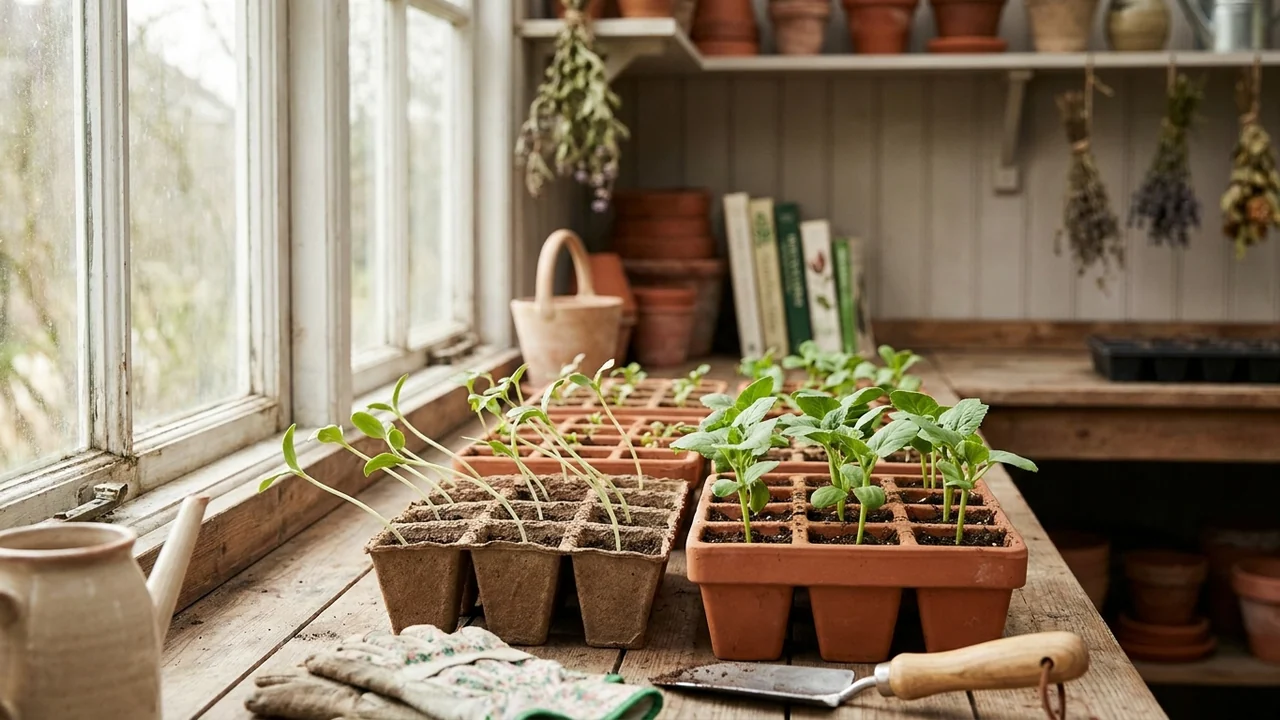
Almost every seed starting failure traces back to a handful of decisions made in the first two weeks, long before the seedling ever looks unhappy. Sowing too early, trusting a bright window, watering on a schedule instead of by weight: none of these look like mistakes on day four. They look like mistakes on day thirty, when you are holding a pale, floppy stem and wondering where it went sideways. Here are the seven that account for most of it, roughly in the order they tend to bite.
1. Starting too early
The clock that matters is your average last frost date, counted backward. A tomato sown ten weeks out does not become a bigger transplant than one sown six weeks out; it becomes a stressed one that outgrew its cell, set flowers indoors, and stalled after planting.
| Crop | Sow indoors | Move outside |
|---|---|---|
| Tomatoes | 6-8 weeks before last frost | 1-2 weeks after last frost |
| Peppers, eggplant | 8-10 weeks before | 2-3 weeks after |
| Basil | 6 weeks before | once nights stay above 50F |
| Broccoli, cabbage, kale | 6-8 weeks before | 2-4 weeks before last frost |
| Lettuce, spinach | 4-6 weeks before | 3-4 weeks before |
| Cucumbers, squash, melons | 3-4 weeks before | 1-2 weeks after |
| Onions, leeks | 10-12 weeks before | 4 weeks before |
Mark your average last frost date on a calendar first, then count backward for each crop. Every number above is relative to that single date. Tomatoes get the full treatment in our guide to when to plant tomatoes.
2. Treating a bright window as a light source
A south-facing window in February is dramatically dimmer than an overcast day outdoors, and the light arrives sideways. Seedlings respond by stretching toward it, which is the pale, leggy stem almost every first-time grower produces.
- Leggy means underlit, not overwatered or underfed.
- Keep a shop-style LED 2 to 4 inches above the leaf tops and raise it as they grow.
- Run it 14 to 16 hours a day on a cheap outlet timer, then give them darkness.
- Rotating trays daily helps on a windowsill but does not fix the underlying deficit.
A basic two-tube fixture over one tray solves this permanently for the cost of a few flats of nursery starts. Our scored picks live at grow lights.
3. Running a heat mat without a thermostat
Heat mats speed germination, and that is all they are for. Most run roughly 10-20 degrees above ambient with no way to know where they have landed, which is fine under peppers and genuinely harmful under lettuce.
| Stage | What heat does |
|---|---|
| Before sprouting | Warm soil speeds and evens germination, especially peppers and eggplant |
| After sprouting | Extra bottom heat drives stretchy growth and dries the mix fast |
| Cool-season crops | Lettuce and brassicas germinate fine at room temperature |
Pair any mat with an inline thermostat probe pushed into the mix, target the low 70s F for most crops, and turn the mat off once most cells have sprouted. Mats, domes, trays and probes usually come bundled in the kits at seed starting kits.
4. Watering on a schedule, and inviting damping off
Damping off is a fungal collapse: healthy seedlings tip over at the soil line overnight, with a pinched, water-soaked stem. It is a symptom of a saturated, stagnant, cold surface far more often than bad luck.
- Water by weight. Lift the tray; a light tray needs water, a heavy one does not.
- Bottom-water into the tray and pour off whatever is not absorbed within 30 minutes.
- Pull the humidity dome the moment the first seedlings emerge.
- Put a small fan on low across the trays. Air movement suppresses fungus and thickens stems.
- Use a fresh seed starting mix, not garden soil or reused potting mix.
The same read-the-medium instinct carries straight outdoors; see how often to water a vegetable garden.
5. Skipping hardening off
Indoor seedlings have thin cuticles and no wind training. Moving them straight into full sun and open wind is the single most common way to lose a healthy flat in one afternoon, and the damage looks like bleached white patches or shredded leaves.
Spread the transition over 7 to 10 days:
- Days 1-2: one hour in full shade, sheltered from wind.
- Days 3-4: two to four hours, with morning sun only.
- Days 5-7: most of the day out, including a few hours of direct sun.
- Days 8-10: leave them out overnight if frost is not forecast, then transplant on a cloudy day or in the evening.
Skip a day when wind is high or a cold snap arrives. Hardening off is cumulative, not a countdown.
6. Sowing at the wrong depth
Depth failures are silent. Nothing comes up, and there is no evidence to inspect. The old rule holds well: plant a seed about two to three times as deep as it is wide, and read the packet for exceptions.
| Seed | Depth | Note |
|---|---|---|
| Lettuce, celery, snapdragon | Surface, press in | Needs light to germinate |
| Basil, thyme, oregano | Barely covered | Very fine seed |
| Tomato, pepper, brassicas | About 1/4 inch | The default for most vegetables |
| Cucumber, squash, melon | 1/2 to 1 inch | Large seed, plenty of stored energy |
| Beans, peas, corn | 1 to 1.5 inches | Usually better sown directly outdoors |
7. Letting seedlings get root-bound
A seedling that has filled its cell stops growing and starts aging. Roots circle the plug, the lower leaves yellow, and the plant carries that check in growth for weeks after transplanting.
- Pot up into a 3 to 4 inch container when roots show at the drainage holes, or when the plant is roughly three times the height of its cell.
- Bury tomatoes deeper each time you pot up. The buried stem grows new roots.
- Loosen or tease circling roots at final planting rather than dropping the plug in intact.
- If the weather will not cooperate, potting up buys another two or three weeks without stress.
Seedlings that go into loose, warm soil recover fastest, which is one more argument for the beds covered in raised garden beds.
Where this fits on the Primer Path
Seed starting is a four-season skill: it is how you stop shopping the nursery rack and start choosing varieties. If you are earlier in the sequence, get one bed producing first with how to start a vegetable garden, then come back and start your own transplants next winter with a light, a thermostat, and a calendar counted backward from your last frost.
Common questions
Why are my seedlings tall, pale and floppy?+
That is stretching, and it means not enough light. A winter windowsill is far dimmer than it looks. Move seedlings under an LED fixture held two to four inches above the leaves for 14 to 16 hours a day, and raise it as they grow.
Do I really need a heat mat?+
Only for germination, and mainly for warm-season crops like peppers, eggplant and tomatoes. Lettuce and brassicas sprout fine at room temperature. If you use a mat, pair it with a thermostat probe and switch it off once most cells have sprouted.
What causes seedlings to fall over at the soil line?+
Damping off, a fungal collapse that follows wet, stagnant, cool conditions. Prevent it with fresh seed starting mix, bottom watering with the excess poured off, the humidity dome removed at emergence, and a small fan running on low across the trays.
How long does hardening off take?+
Plan on 7 to 10 days. Start with an hour in full shade, add time and direct sun gradually, and leave plants out overnight only once frost has passed. Skip a day when it is windy or cold, then transplant on a cloudy day or in the evening.