Skip to content
GardenPrimer

Best Lawn Fertilizers

Lawn foods and weed-and-feed compared on nitrogen, phosphorus rules, slow versus quick release, and coverage per bag.

Lawn fertilizer is a repeat purchase, so picking the right bag matters every season. We compare everyday lawn foods, starter fertilizer, slow-release organic feeds and weed-and-feed on what the bag's N-P-K and label actually say, coverage per bag, and state phosphorus rules, using extension nitrogen guidance and EPA-registered labels.

5 models scored · Research checked November 17, 2026

Lawn Fertilizers

The quick answer

Scotts Turf Builder Lawn Food is the simple, pesticide-free feed most lawns need, with thousands of owner ratings behind it. Use Scotts Starter Food only when you seed or sod. Scotts WinterGuard is the fall feeding, and The Andersons PGF Complete is the fine-particle pro-style blend for people who spread carefully.

Our picks, in recommended order

The order is our editorial call on overall fit — price, size, setup and the drawbacks you'll live with. The PrimerScore summarizes public owner-rating signals, so the two can disagree. Filter by what matters to you.

We may earn a commission from qualifying Amazon purchases, at no extra cost to you. How affiliate links work.

How much fertilizer per bag? Turn the N-P-K on the bag into pounds of product and number of bags for your lawn, using extension nitrogen guidance.

Open the tool →

Showing all 5 picks

Pick 1
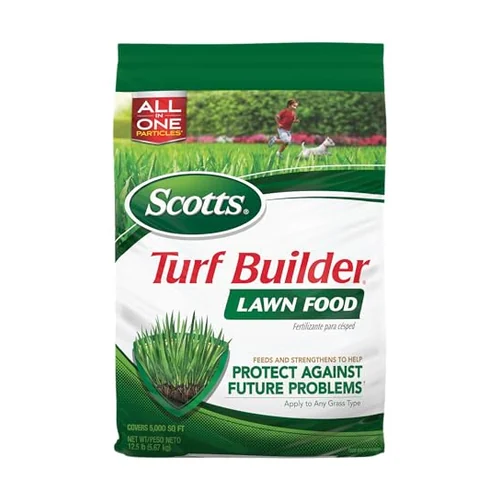
Turf Builder Lawn Food, 12.5 lb

A pesticide-free granular lawn food for any grass type that goes down on a wet or dry lawn in spring, summer or fall.

Picked for: Routine feeding

✓ Works on any grass type✕ 32-0-4 covering 5,000 sq ft per bag, per Scotts, so larger lawns need two
Our research on the Scotts Turf Builder Lawn Food, 12.5 lb

The everyday, low-cost feeding for any lawn. Scotts lists this bag as 32-0-4 (nitrogen, phosphorus, potassium) with no phosphorus and no weed killer, covering up to 5,000 sq ft. It goes on a wet or dry lawn any time in the growing season, watering in is optional, and Scotts says to repeat every 6 to 8 weeks, up to 4 times a year. That makes it the simplest routine choice here. The trade-off: it is a plain quick-greening food without the slow-release blend and iron of Andersons PGF Complete, so follow the spreader setting to avoid overdoing it.

Best for
Beginners who want a cheap, simple feeding routine for an established lawn of any grass type.
Skip it if
You are seeding or laying sod this week; Scotts Starter Food is built for new grass.
  • Works on any grass type
  • No pesticide, so no weed-killer restrictions
  • Apply to wet or dry grass
  • 32-0-4 covering 5,000 sq ft per bag, per Scotts, so larger lawns need two
  • Quick-feeding synthetic, easy to overapply
Grass typesAll
PesticideNone
When to applySpring, summer or fall
Size12.5 lb
N-P-K32-0-4
CoverageUp to 5,000 sq ft
How oftenEvery 6 to 8 weeks, up to 4× a year

Sources

Research checked Nov 17, 2026. We research picks; we don't test them.
Pick 2
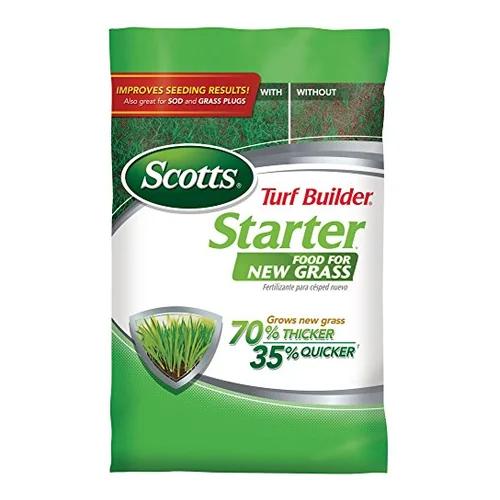
Turf Builder Starter Food for New Grass, 15 lb

A 24-25-4 starter fertilizer for the day you seed, sod or plug, safe on any grass type and covering 5,000 sq ft per bag.

Picked for: New seed or sod

✓ Made for seeding, sod, sprigs and plugs✕ High phosphorus: for new lawns, not routine feeding
Our research on the Scotts Turf Builder Starter Food for New Grass, 15 lb

The pick for the day you plant. Scotts' 24-25-4 formula is unusually high in phosphorus, the nutrient new roots use, and the label covers seeding, reseeding, sod, sprigs and plugs on any grass type. Scotts says to apply it right before or right after planting, and one 15 lb bag covers 5,000 sq ft. Scotts claims new grass grows 70% thicker and 35% faster on average than unfed grass. The trade-off: that phosphorus is wasted on an established lawn, so switch to Turf Builder Lawn Food or PGF Complete once the new grass is growing.

Best for
Anyone seeding a new lawn, overseeding thin areas or laying sod who wants a feed matched to new roots.
Skip it if
Your lawn is established and you are not planting; Turf Builder Lawn Food suits routine feeding.
  • Made for seeding, sod, sprigs and plugs
  • Covers 5,000 sq ft
  • Any grass type
  • High phosphorus: for new lawns, not routine feeding
  • Wrong choice on established lawns with no soil-test need
N-P-K24-25-4
Coverage5,000 sq ft per 15 lb
UseNew seed, sod, sprigs or plugs
Grass typesAll
How oftenAt planting, before or after seeding
Rotary spreader setting3¼ (Scotts broadcast)

Sources

Research checked Nov 17, 2026. We research picks; we don't test them.
Pick 3
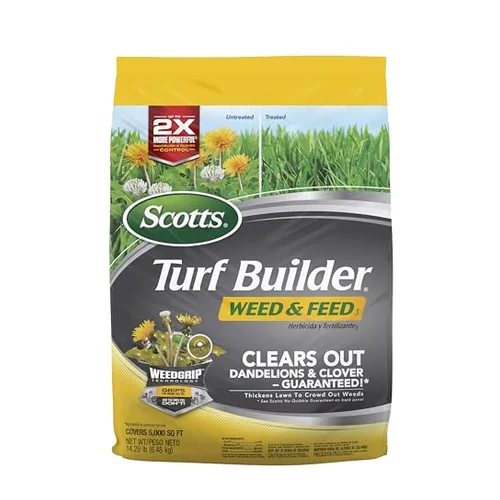
Turf Builder Weed & Feed3, 14.29 lb

A granular fertilizer plus broadleaf weed control for dandelions and clover, applied to wet grass so particles stick to the weeds.

Picked for: Includes weed control

✓ Feeds and treats dandelions and clover in one pass✕ Label bars St. Augustine, bentgrass, carpetgrass and others
Our research on the Scotts Turf Builder Weed & Feed3, 14.29 lb

This is the one pick here that both feeds the lawn and treats broadleaf weeds such as dandelions and clover, so a lawn with scattered weeds gets one granular pass instead of a feed plus a separate sprayer. The granules go down on wet grass so they stick to weed leaves. The trade-offs come from the weed-control part: the label rules out St. Augustine, bentgrass, carpetgrass and some other grasses, and you cannot seed for about a month afterwards. If your lawn has no weeds, a plain lawn food is the better buy.

Best for
Owners of established bluegrass, fescue, rye, bermuda or zoysia lawns with scattered dandelions and clover.
Skip it if
You have St. Augustine grass or plan to seed soon; use Turf Builder Lawn Food or Starter Food instead.
  • Feeds and treats dandelions and clover in one pass
  • Very large owner-rating history
  • Granular, no sprayer needed
  • Label bars St. Augustine, bentgrass, carpetgrass and others
  • No seeding for a month after applying, per the label
TypeFertilizer plus broadleaf weed control
TargetsDandelion and clover
ApplicationGranules on wet grass
Size14.29 lb

No maker or retailer spec page found, so these details come from the Amazon listing. Research checked Nov 17, 2026.

Pick 4
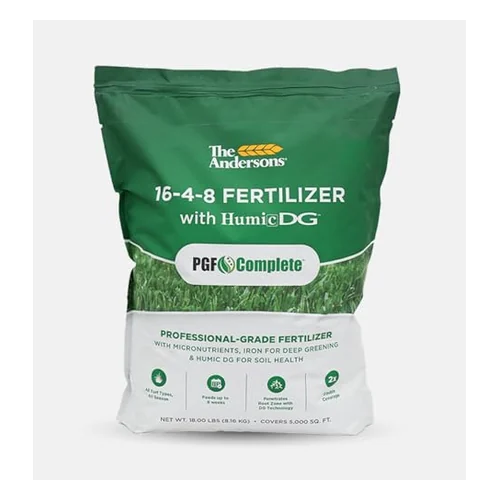
Professional PGF Complete 16-4-8 with Humic DG

A fine-particle 16-4-8 blend with quick and slow-release nitrogen, iron and humic acid, covering 5,000 sq ft for even, careful feeding.

Picked for: Routine feeding · Slow release

✓ Super-fine particles spread evenly✕ Priciest per bag here
Our research on the The Andersons Professional PGF Complete 16-4-8 with Humic DG

The careful-feeder pick. The Andersons say ordinary consumer granules are about 60% bigger than PGF Complete's, and the smaller particles give roughly twice as many per square foot, for more even coverage. Nitrogen is a mix of quick-release, for fast green-up, and slow-release that feeds for up to 8 weeks, plus iron, micronutrients and Humic DG (a humic acid soil additive). The maker says it suits all turf types while actively growing, reapplied at 6 to 8 week intervals. The trade-offs: the highest price per bag here, and the bag says not for sale in California.

Best for
Lawn owners who want an even, longer-lasting feed with iron and are happy to pay more per bag.
Skip it if
You live in California or want the lowest cost per feeding; Turf Builder Lawn Food is far cheaper.
  • Super-fine particles spread evenly
  • Quick plus slow-release nitrogen, up to 8 weeks
  • Iron and micronutrients included
  • Priciest per bag here
  • Contains phosphorus; not for sale in California
N-P-K16-4-8
Coverage5,000 sq ft
ReleaseQuick and slow, up to 8 weeks (manufacturer)
ExtrasIron, micronutrients, humic DG
How oftenEvery 6 to 8 weeks in growing season
Bag sizes18 lb/5,000 or 40 lb/11,100 sq ft

Sources

Research checked Nov 17, 2026. We research picks; we don't test them.
Pick 5
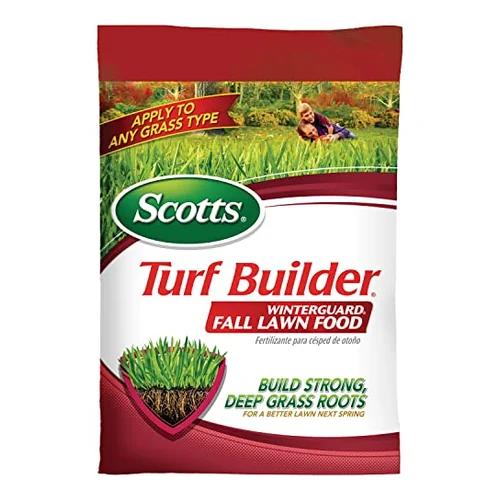
Turf Builder WinterGuard Fall Lawn Food, 10 lb

A fall lawn food for any grass type that helps lawns recover from summer and build roots before winter, covering 4,000 sq ft.

Picked for: Routine feeding

✓ Made for the fall feeding✕ Fall-only product
PrimerScore 89Unavailable
Currently unavailable
Full review →
Our research on the Scotts Turf Builder WinterGuard Fall Lawn Food, 10 lb

The single fall feeding, and the only pick here made for that job. Scotts lists WinterGuard as 32-0-10, with more potassium than the everyday Lawn Food, applied once between August and November to help grass recover from summer and build roots before winter, for faster green-up in spring. It works on any grass type, goes on a wet or dry lawn, and Scotts says watering in is optional and people and pets can go back on the lawn right away. The trade-off: it is a one-season product, and this 10 lb bag covers 4,000 sq ft, so bigger lawns need more bags.

Best for
Homeowners who feed once or twice a year and want the one feeding that matters most before winter.
Skip it if
You want a spring or summer feed; Turf Builder Lawn Food or PGF Complete fit the growing season.
  • Made for the fall feeding
  • Any grass type
  • Wet or dry lawn
  • Fall-only product
  • Small bag for large lawns
UseFall feeding
Coverage4,000 sq ft per 10 lb
Grass typesAll
ApplicationWet or dry lawn
N-P-K32-0-10
How oftenOnce in fall, August to November
Rotary spreader setting2¾ (Scotts broadcast)

Sources

Research checked Nov 17, 2026. We research picks; we don't test them.

Comparison of every lawn fertilizer pick
Pick
Scotts Turf Builder Lawn Food, 12.5 lb#1
BudgetScotts Turf Builder Lawn Food, 12.5 lb
Scotts Turf Builder Starter Food for New Grass, 15 lb#2
Mid-rangeScotts Turf Builder Starter Food for New Grass, 15 lb
Scotts Turf Builder Weed & Feed3, 14.29 lb#3
PremiumScotts Turf Builder Weed & Feed3, 14.29 lb
The Andersons Professional PGF Complete 16-4-8 with Humic DG#4
PremiumThe Andersons Professional PGF Complete 16-4-8 with Humic DG
Scotts Turf Builder WinterGuard Fall Lawn Food, 10 lb#5
BudgetScotts Turf Builder WinterGuard Fall Lawn Food, 10 lb
Price & buy

$26.98

Check price on Amazon

$34.97

Check price on Amazon

$64.99

Check price on Amazon

$59.88

Check price on Amazon

Unavailable

Currently unavailable

Prices checked Oct 2, 2026 and change often. Specs are as the manufacturers state them. We may earn a commission from qualifying Amazon purchases.

How to choose lawn fertilizer

Read the three numbers

The numbers on the bag are the percent nitrogen, phosphate and potash by weight, in that order. Extension guidance works in pounds of nitrogen per 1,000 square feet: NC State's new-seeding advice, for example, is about 1 pound per 1,000 sq ft, with a quarter to half of it slow-release. Our fertilizer calculator turns any bag into pounds and bag counts.

Phosphorus is regulated in some states

Minnesota bans phosphorus lawn fertilizer unless a soil test shows a need or you are establishing a new lawn by seed or sod, and a zero in the middle number means phosphorus-free. Other states have similar rules, so check yours. Sweep any granules off driveways and sidewalks back onto the lawn.

Time it to your grass

NC State advises against high nitrogen on cool-season grasses in late spring or summer, and on warm-season grasses in fall or winter. Treat weed-and-feed as a weed treatment, not a routine feeding: NC State says to use it only when there are enough weeds to justify it, and its label restricts which lawns it can go on.

Common questions

Is weed and feed bad for your lawn?

It isn't bad, but it's a pesticide as well as a fertilizer. NC State Extension says to use weed-and-feed only when weeds are numerous enough to need treatment, not every time you fertilize. Scotts' EPA label says not to use it on St. Augustinegrass and several other grasses, and to wait a month after applying before seeding.

Do I need phosphorus in lawn fertilizer?

Usually only when seeding a new lawn or when a soil test shows a shortage. Minnesota law, for example, allows phosphorus lawn fertilizer only in those cases. A bag with a zero as the middle number is phosphorus-free.

How much lawn fertilizer should I use?

Follow the bag's spreader setting and coverage, which the label bases on its nitrogen content. Extension guidance is stated in pounds of nitrogen per 1,000 square feet per application, so a bag with a higher first number covers more lawn per pound. Our calculator does the math for any N-P-K.

More in Lawn Treatments