Skip to content
GardenPrimer

Best Wasp & Hornet Control

Long-reach nest sprays, a ground-nest foam and a yellowjacket trap, with extension advice on when to leave a nest to a pro.

Most wasp problems come down to one decision: leave the nest alone, treat it yourself, or call a professional. We compare long-reach nest sprays, a foam for ground nests and a reusable yellowjacket trap on reach, where each label says to use it, and the honest limits of traps.

5 models scored · Research checked November 17, 2026

Wasp & Hornet Control

The quick answer

For a paper wasp or hornet nest under an eave, Raid's two-can jet spray reaches up to 22 feet and gives you a second can for follow-up. SpectracidePRO is the cheaper single can. BASF Wasp-Freeze is the professional-line quick-knockdown option. If anyone in the house is allergic to stings, call a professional instead.

Our picks, in recommended order

The order is our editorial call on overall fit — price, size, setup and the drawbacks you'll live with. The PrimerScore summarizes public owner-rating signals, so the two can disagree. Filter by what matters to you.

We may earn a commission from qualifying Amazon purchases, at no extra cost to you. How affiliate links work.

Showing all 5 picks

Pick 1
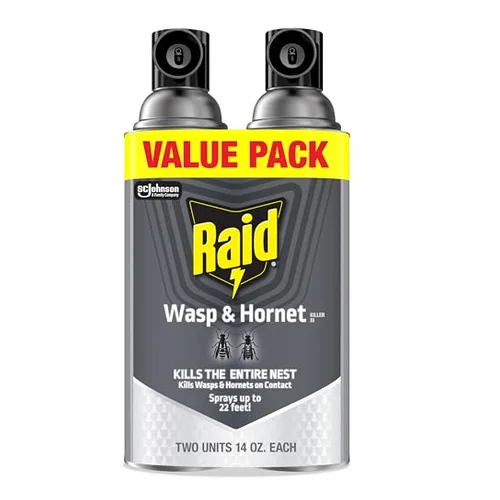
Wasp & Hornet Killer Spray, 14 oz 2-Pack

Two cans of jet spray that reach up to 22 feet, labeled for paper wasps, yellowjackets, mud daubers and bald-faced hornets.

Picked for: Nests under eaves · Long reach

✓ 22-foot reach keeps you back from the nest✕ No spray stops every wasp that flies out
Our research on the Raid Wasp & Hornet Killer Spray, 14 oz 2-Pack

This pick has the longest reach on the list, which is what matters most when a nest hangs under the eaves: Raid rates the jet spray at up to 22 feet. The two-can pack leaves a second can for a follow-up if wasps return. The label says to spray in early morning or early evening when activity is lowest, stand a safe distance away rather than directly under the nest, and wait at least 24 hours before knocking the nest down. It is electrically non-conducting up to 32,500 volts and extremely toxic to fish, so keep it away from ponds. Like every spray, it cannot reach deep ground nests.

Best for
A homeowner with a paper wasp or hornet nest high under the eaves who wants maximum distance from it.
Skip it if
The nest is in a hole in the ground; the Spectracide foam with an extension tube is made for that.
  • 22-foot reach keeps you back from the nest
  • Second can for a follow-up treatment
  • Top owner rating at 4.7 stars
  • No spray stops every wasp that flies out
  • Can't reach deep into ground nests
ReachUp to 22 ft
Size14 oz x 2
Listed pestsPaper wasps, yellowjackets, mud daubers, bald-faced hornets
Non-conductingUp to 32,500 volts
Active ingredientPrallethrin 0.02%, cypermethrin 0.05%
When to applyEarly morning or early evening

Sources

Research checked Nov 17, 2026. We research picks; we don't test them.
Pick 2
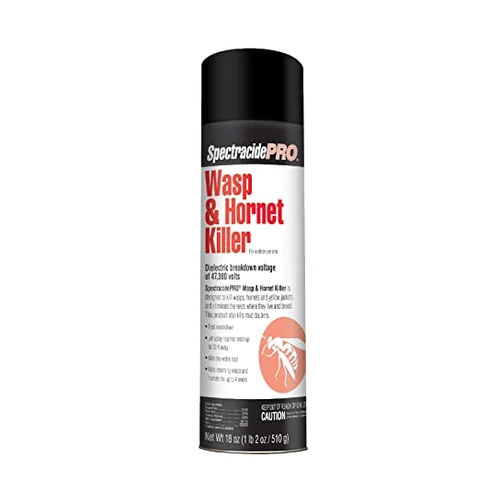
PRO Wasp & Hornet Killer Spray, 18 oz

An 18 oz jet spray that reaches up to 20 feet; the label says to apply at sunrise or sunset and claims up to 4 weeks against returning wasps.

Picked for: Nests under eaves · Long reach

✓ Low price for a large 18 oz can✕ Slightly shorter reach than Raid
Our research on the Spectracide PRO Wasp & Hornet Killer Spray, 18 oz

This is the lowest-cost can on the list and also the largest at 18 oz. Retail listings put its jet reach at up to 20 feet, a little short of Raid's 22, and list wasps, hornets, yellowjackets and mud daubers. Spectracide also claims up to 4 weeks of residual action on wasps that return to a treated nest. Its label calls for spraying at sunrise or sunset, when most of the colony is home. It is labeled for outdoor use only, so it is not the pick for a nest in an attic.

Best for
A budget-minded buyer with an outdoor nest on a porch, fence or eave who wants plenty of spray in one can.
Skip it if
The nest is in an attic or crawl space; the BASF PT Wasp-Freeze II is labeled for those spots.
  • Low price for a large 18 oz can
  • Label spells out sunrise or sunset timing
  • Residual on returning wasps, per maker
  • Slightly shorter reach than Raid
  • Outdoor use only
ReachUp to 20 ft
Size18 oz
Listed pestsWasps, hornets, yellowjackets, mud daubers
When to applySunrise or sunset
Non-conductingUp to 47,300 volts

Sources

Research checked Nov 17, 2026. We research picks; we don't test them.
Pick 3
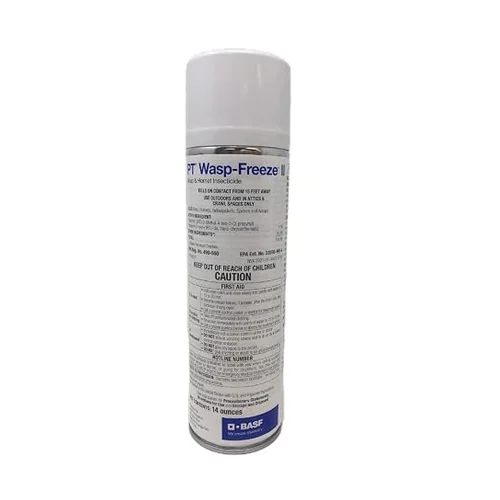
PT Wasp-Freeze II Insecticide, 14 oz

A professional-line quick-knockdown spray that reaches up to 15 feet, labeled for use outdoors and in attics and crawl spaces, including on spiders.

Picked for: Nests under eaves

✓ Built for fast knockdown✕ Flammable: listing notes flame projection over 18 in
Our research on the BASF PT Wasp-Freeze II Insecticide, 14 oz

This is the professional-line pick, built around fast knockdown. BASF says the spray drops wasps and hornets so quickly that they don't release the alarm pheromone that triggers stinging, and it is also labeled for spiders. BASF lists it for outdoors, attics and crawl spaces, which none of the other sprays here cover. It reaches up to 15 feet, shorter than Raid or Spectracide, and BASF notes flame projection of more than 18 inches, so never spray it near a pilot light or grill.

Best for
Someone dealing with a nest in an attic, a crawl space or a tight spot who wants the fastest knockdown.
Skip it if
The nest is high and far away; the Raid spray reaches up to 22 feet compared with 15.
  • Built for fast knockdown
  • Labeled for outdoors, attics and crawl spaces
  • Also labeled for spiders
  • Flammable: listing notes flame projection over 18 in
  • Shorter 15 ft reach; may stain asphalt and shingles
ReachUp to 15 ft
Size14 oz
UseOutdoors, attics and crawl spaces
CautionMay stain asphalt and shingles
Active ingredientPrallethrin
Non-conductingUp to 47,400 volts

Sources

Research checked Nov 17, 2026. We research picks; we don't test them.

Pick 4
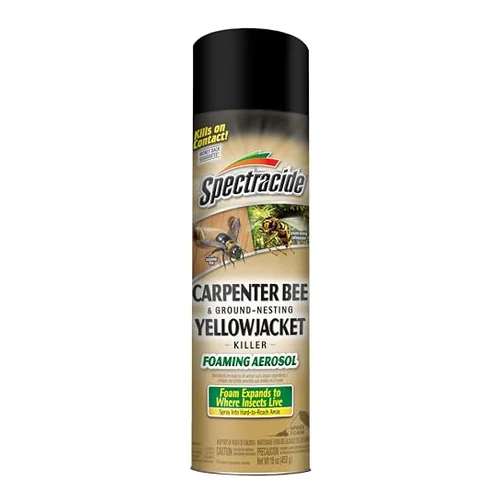
Carpenter Bee & Ground-Nesting Yellowjacket Killer, 16 oz

A foaming aerosol with an extension tube for ground-nest holes and carpenter bee tunnels; the label advises early morning or late evening.

Picked for: Ground nests

✓ Extension tube reaches into holes✕ Ground nests can extend past the foam's reach
Our research on the Spectracide Carpenter Bee & Ground-Nesting Yellowjacket Killer, 16 oz

This is the only product on the list made for nests you can't spray from a distance: holes in the ground and carpenter bee tunnels in wood. An extension tube puts the foam straight into the hole. For yellowjackets, the directions say to spray early morning or late evening when most are in the nest, then cover the hole with soil after 24 hours. For carpenter bees, leave the hole open 48 hours so bees carry the insecticide through the tunnel, then plug it. It is a close-range job, so sting risk is higher than with a jet spray.

Best for
A homeowner with yellowjackets coming out of a hole in the lawn or carpenter bees boring into a deck or fascia.
Skip it if
The nest hangs from the eaves; Raid or Spectracide PRO jet sprays reach it from 20 feet or more.
  • Extension tube reaches into holes
  • Foam expands into the nest
  • Also treats carpenter bee tunnels
  • Ground nests can extend past the foam's reach
  • Close-range job, so sting risk is higher
FormatFoaming aerosol with extension tube
Size16 oz
TargetsCarpenter bees, ground-nesting yellowjackets
When to applyEarly morning or late evening

Sources

Research checked Nov 17, 2026. We research picks; we don't test them.

Pick 5
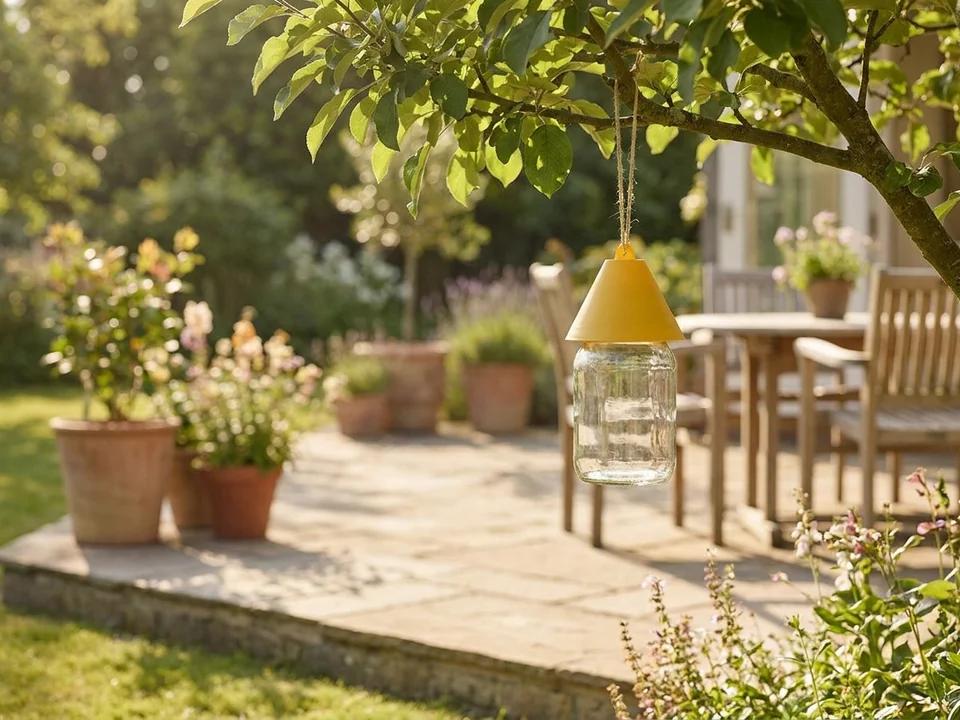
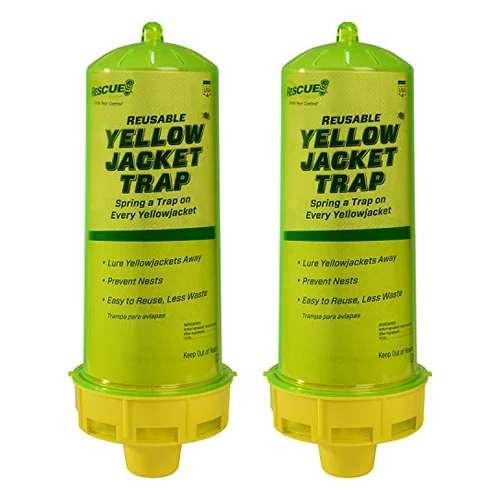
Reusable Yellowjacket Trap, 2-Pack

A spray-free lure trap for yellowjackets around patios; the maker says it targets about a dozen yellowjacket species but not wasps or hornets.

Picked for: Spray-free

✓ No insecticide near your table✕ Yellowjackets only; won't clear a large population
Our research on the RESCUE! Reusable Yellowjacket Trap, 2-Pack

This is the only spray-free pick, aimed at yellowjackets that crowd a patio table. RESCUE! says it targets roughly a dozen North American yellowjacket species, is not designed for hornets or paper wasps, and is designed to avoid trapping honeybees. Hang it at least 20 feet from where people sit so it draws yellowjackets away. The included lure lasts about 2 to 4 weeks, and refills are sold separately. Setting it out in early spring can catch queens before they build nests. It won't clear an established nest; use a spray for that.

Best for
A family that eats outside and wants fewer yellowjackets around the table without spraying insecticide nearby.
Skip it if
You have a paper wasp or hornet nest; the Raid or Spectracide PRO spray treats it directly.
  • No insecticide near your table
  • Reusable with attractant refills
  • Designed not to attract honeybees, per maker
  • Yellowjackets only; won't clear a large population
  • Far fewer owner reviews than the sprays
TargetsYellowjackets only (not wasps or hornets)
Count2 traps
AttractantIncluded; refills sold separately
BuildReusable plastic
Attractant lifeAbout 2–4 weeks per lure
Made inUSA

Sources

Research checked Nov 17, 2026. We research picks; we don't test them.

Comparison of every wasp & hornet pick
Pick
Raid Wasp & Hornet Killer Spray, 14 oz 2-Pack#1
BudgetRaid Wasp & Hornet Killer Spray, 14 oz 2-Pack
Spectracide PRO Wasp & Hornet Killer Spray, 18 oz#2
BudgetSpectracide PRO Wasp & Hornet Killer Spray, 18 oz
BASF PT Wasp-Freeze II Insecticide, 14 oz#3
PremiumBASF PT Wasp-Freeze II Insecticide, 14 oz
Spectracide Carpenter Bee & Ground-Nesting Yellowjacket Killer, 16 oz#4
BudgetSpectracide Carpenter Bee & Ground-Nesting Yellowjacket Killer, 16 oz
RESCUE! Reusable Yellowjacket Trap, 2-Pack#5
Mid-rangeRESCUE! Reusable Yellowjacket Trap, 2-Pack
Price & buy

$10.58

Check price on Amazon

$8.27

Check price on Amazon

$15.20

Check price on Amazon

$6.99

Check price on Amazon

$26.99

Check price on Amazon

Prices checked Oct 10, 2026 and change often. Specs are as the manufacturers state them. We may earn a commission from qualifying Amazon purchases.

How to choose wasp & hornet

Decide whether the nest has to go

University of Kentucky entomologists say avoidance is often the best advice when a nest is out of the way, and that in much of the US yellowjacket colonies die off on their own in late autumn. UC IPM notes social wasps also eat large numbers of pest insects. If a nest is by a door or play area, or anyone nearby is allergic, then act, or better, hire a pro.

Treat after dark, from as far away as you can

University of Kentucky guidance is to find the nest opening in daylight, then treat late at night when the wasps are home. Don't shine a flashlight straight at the entrance; set it on the ground to one side. UC IPM warns that stings are still likely even after dark with a 20-foot spray, so wear clothing that covers you completely, plus gloves, eye protection and a veil.

Know what traps can and can't do

UC IPM says lure traps can reduce local foraging yellowjackets but don't eliminate large populations, and the common lure attracts mainly the western yellowjacket. Trapping isn't suggested for other social wasps. Hang traps away from where people eat, and handle them when yellowjackets are less active, early morning or dusk, per Oregon State University.

Common questions

When should I call a professional for a wasp or hornet nest?

Call one if anyone nearby is allergic to stings, the nest is hard to reach, or you're uneasy about it. UC IPM says hiring a professional reduces the risk to you and your family. If someone who's been stung gets hives, trouble breathing or swallowing, or starts wheezing, University of Kentucky entomologists say to get medical attention immediately.

Is it better to spray a wasp nest at night or during the day?

At night or at the very edge of the day. University of Kentucky guidance says to treat late at night after the wasps are in the nest, and many spray labels say to apply at sunrise or sunset. Find the entrance in daylight first, keep your light off the opening, and follow the label.

Do yellowjacket traps actually work?

They help a little around a patio but won't clear a yard. University of Kentucky calls them of marginal benefit, and UC IPM says the common lure mainly attracts the western yellowjacket. Oregon State University says traps set in early spring can stop yellowjacket queens from starting new nests. Most traps don't catch paper wasps or hornets.