Skip to content
GardenPrimer

Best Pool Test Kits

Test strips vs drop kits for pools and hot tubs, with what free chlorine, pH, alkalinity and CYA mean and the CDC ranges.

Clear water isn't the same as safe water, and a test kit is how you know the difference. We compare strips and drop-based kits on which readings each measures, how much judgment the color matching takes, and what refills cost. The target ranges come straight from CDC guidance.

5 models scored · Research checked November 17, 2026

Pool Test Kits

Our picks, in recommended order

The order is our editorial call on overall fit — price, size, setup and the drawbacks you'll live with. The PrimerScore summarizes public owner-rating signals, so the two can disagree. Filter by what matters to you.

We may earn a commission from qualifying Amazon purchases, at no extra cost to you. How affiliate links work.

Turn your test result into a dose Enter your pool size and free chlorine reading to see how much chlorine to add, with CDC recommended ranges.

Open the tool →

Showing all 5 picks

Pick 1
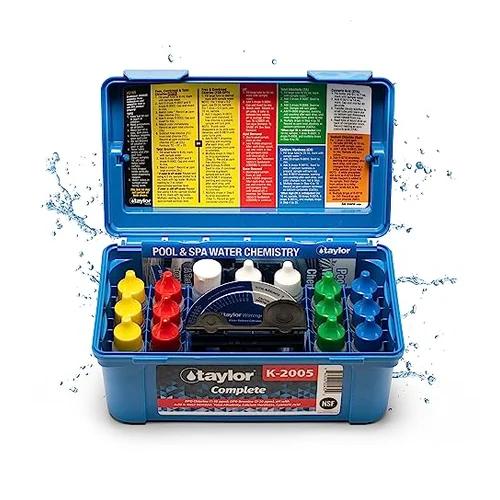
K-2005 DPD 9-in-1 Complete Pool Test Kit

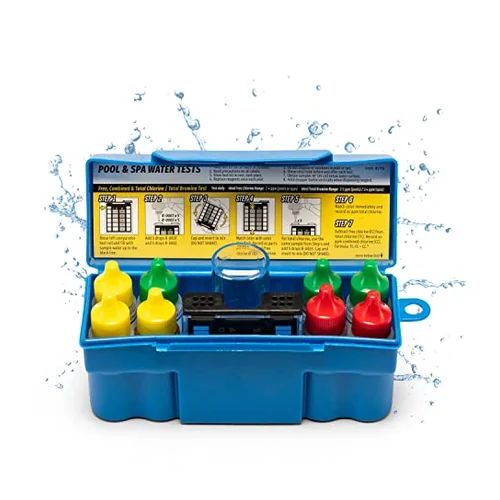
A DPD drop kit with 13 reagents covering 9 readings: free and total chlorine, bromine, pH, acid and base demand, alkalinity, hardness and CYA.

Picked for: Drop-based kits · Works for hot tubs

✓ Covers every reading a chlorine pool needs, including CYA✕ Takes several minutes per full test
Our research on the Taylor Technologies K-2005 DPD 9-in-1 Complete Pool Test Kit

This is the list's all-rounder: Taylor's Complete kit tests free and total chlorine, bromine, pH with acid and base demand, total alkalinity, calcium hardness and cyanuric acid (CYA, the stabilizer that shields chlorine from sun). Only it and the salt kit cover hardness and CYA, which strips read only roughly. Chlorine is read by color matching in steps of 1, 2, 3, 5, 7.5 and 10 ppm; Taylor says the K-2006 differs only in using a drop-count chlorine test. The trade-off is time and upkeep: each test is a few steps, and Taylor recommends replacing reagents seasonally.

Best for
Chlorine or bromine pool owners who want every routine water-balance reading, including hardness and CYA, from one kit.
Skip it if
You only need quick chlorine and pH checks; the AquaChek strips or the cheaper Taylor K-1004 do that for less.
  • Covers every reading a chlorine pool needs, including CYA
  • Drop tests give firmer numbers than strips
  • Replacement reagents sold separately, so the kit lasts
  • Takes several minutes per full test
  • Reagents are a seasonal repeat purchase
MethodDPD liquid reagents
Tests9 parameters incl. free chlorine and CYA
Reagents13 included
Made inUSA
Chlorine readout1–10 ppm color steps
pH scale7.0–8.0
CYA readout30–100 ppm
Bromine readout2–20 ppm

Sources

Research checked Nov 17, 2026. We research picks; we don't test them.
Pick 2
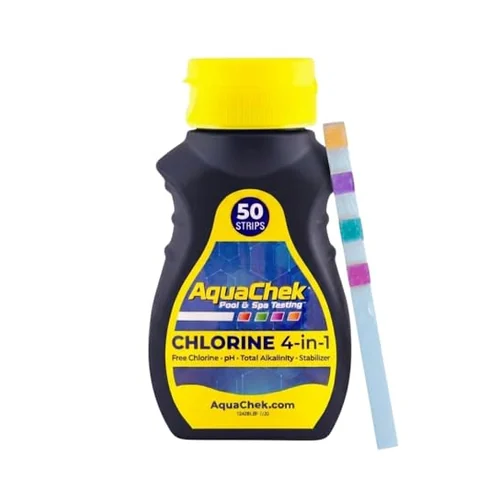
Yellow 4-Way Pool and Spa Test Strips, 50 Count

A 50-strip bottle reading free chlorine, pH, total alkalinity and cyanuric acid, sized for a season of quick checks.

Picked for: Quick test strips · Best value

✓ The four numbers a chlorine pool needs most✕ Less accurate than a drop kit, per CDC
Our research on the AquaChek Yellow 4-Way Pool and Spa Test Strips, 50 Count

The cheapest way onto this list: one dip reads the four numbers a chlorine pool is checked for most — free chlorine, pH, total alkalinity and cyanuric acid. AquaChek lists free chlorine at 0–10 ppm, pH 6.2–8.4, alkalinity 0–240 ppm and stabilizer 0–300 ppm. There are no reagents to measure or mix, so it suits a quick weekly check. The trade-offs: strips give color-band estimates rather than a drop count, and there is no bromine or hardness reading, so bromine hot tubs need the Silver 7-way strips or a Taylor kit.

Best for
Chlorine pool owners who want a fast, low-cost routine check of chlorine, pH, alkalinity and stabilizer.
Skip it if
You run a bromine spa or want hardness readings; the AquaChek 7-way Silver strips cover both.
  • The four numbers a chlorine pool needs most
  • Results in seconds, no reagents
  • 4.7 stars from more than 16,000 owners
  • Less accurate than a drop kit, per CDC
  • No bromine reading for bromine hot tubs
FormatTest strips, 50 count
TestsFree chlorine, pH, alkalinity, CYA
ForChlorine pools and spas
RefillRebuy the bottle
Chlorine readoutFree chlorine 0–10 ppm
pH scale6.2–8.4
CYA readout0–300 ppm
Bromine readoutNot tested

Sources

Research checked Nov 17, 2026. We research picks; we don't test them.
Pick 3
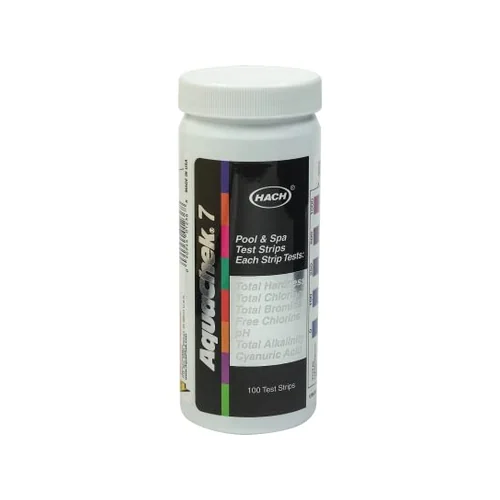
7-Way Pool and Spa Test Strips, 100 Count

Silver strips that read seven values, including bromine and total hardness, which makes them handy for hot tubs as well as pools.

Picked for: Quick test strips · Works for hot tubs

✓ Reads bromine as well as chlorine✕ Strip CYA and pH readings are approximate
Our research on the AquaChek 7-Way Pool and Spa Test Strips, 100 Count

The strip pick for hot tubs and mixed setups: AquaChek's Silver strips add total bromine (0–20 ppm), total chlorine and total hardness (0–1,000 ppm) to the four readings on the Yellow strips. That means one bottle covers a chlorine pool and a bromine spa, and its free chlorine scale runs to 20 ppm versus 10 on the Yellow. The 100-count bottle costs about twice the 4-way. As with any strip, readings are color-band estimates, so a Taylor drop kit is the better tool when you need a firm number before adding chemicals.

Best for
Owners of a hot tub, or a pool plus a bromine spa, who want quick strip checks including bromine and hardness.
Skip it if
You only test a chlorine pool; the cheaper AquaChek Yellow 4-way reads the numbers you need.
  • Reads bromine as well as chlorine
  • 100 strips per bottle
  • Dip, wait 15 seconds and compare
  • Strip CYA and pH readings are approximate
  • Costs more than the 4-way bottle
FormatTest strips, 100 count
TestspH, total and free chlorine, bromine, alkalinity, hardness, CYA
Read time15 seconds
MethodDip, then match the color chart
Chlorine readoutFree chlorine 0–20 ppm
pH scale6.2–8.4
CYA readout0–300 ppm
Bromine readout0–20 ppm

Sources

Research checked Nov 17, 2026. We research picks; we don't test them.

Pick 4
K-1004 DPD 6-in-1 Pool Test Kit

An entry-level DPD drop kit with 8 reagents for free and total chlorine, bromine, pH, acid demand and total alkalinity.

Picked for: Drop-based kits · Best value · Works for hot tubs

✓ Drop-test accuracy at a strip-like price✕ No CYA or calcium hardness test
Our research on the Taylor Technologies K-1004 DPD 6-in-1 Pool Test Kit

The low-cost way into drop testing. Taylor's 6-way kit reads free and total chlorine, bromine, pH with acid demand, and total alkalinity, and Taylor describes it as built for homeowners with straightforward instructions. Like the bigger kits it separates free from total chlorine, which strips on this list cannot do as precisely. The catch is scope: there is no calcium hardness or CYA test, and its chlorine color scale stops at 5 ppm (0.5 to 5), so a pool kept at higher chlorine or one that needs stabilizer checks is better served by the K-2005.

Best for
Spa owners and small-pool owners who want drop-test chlorine or bromine and pH readings on a budget.
Skip it if
You need hardness and stabilizer readings; the Taylor K-2005 covers both.
  • Drop-test accuracy at a strip-like price
  • Separates free from total chlorine
  • Works for pools and bromine spas
  • No CYA or calcium hardness test
  • Reagents need replacing each season
MethodDPD liquid reagents
TestsFree and total chlorine, bromine, pH, acid demand, alkalinity
Reagents8 included
Made inUSA
Chlorine readout0.5–5 ppm color steps
pH scale6.8–8.2
CYA readoutNot tested
Bromine readout1–10 ppm

Sources

Research checked Nov 17, 2026. We research picks; we don't test them.

Pick 5
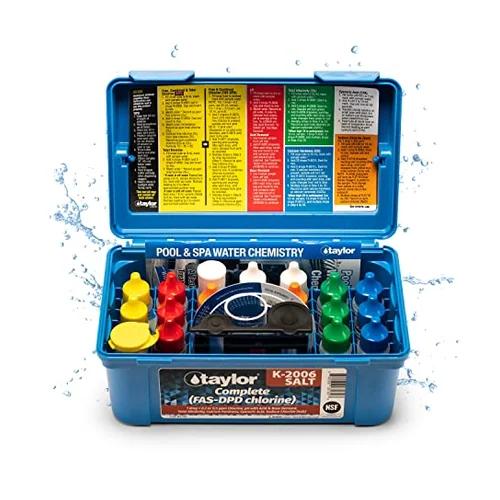
K-2006-SALT FAS-DPD 9-in-1 Saltwater Pool Test Kit

A FAS-DPD high-range kit for saltwater pools, with 15 reagents covering chlorine, pH, alkalinity, hardness, CYA and salt.

Picked for: Drop-based kits

✓ FAS-DPD method for high-range chlorine readings✕ Priciest kit here
Our research on the Taylor Technologies K-2006-SALT FAS-DPD 9-in-1 Saltwater Pool Test Kit

The kit for saltwater pools. It adds a sodium chloride (salt) test, which Taylor rates at 200 ppm per drop, to free and combined chlorine, pH, alkalinity, calcium hardness and CYA. Chlorine is measured by FAS-DPD, a drop-count titration where each drop equals 0.2 or 0.5 ppm, rather than by matching a color, which avoids judging shades at high chlorine levels. It is the priciest kit here and drops the bromine test the K-2005 has. Taylor sells it in 0.75 oz bottles or a 2 oz size for heavier testing.

Best for
Salt-chlorinator pool owners who want salt, CYA, hardness and precise chlorine readings in one kit.
Skip it if
Your pool is not saltwater or you use bromine; the Taylor K-2005 covers the rest for less.
  • FAS-DPD method for high-range chlorine readings
  • Adds a salt (chloride) test for salt pools
  • Covers CYA and calcium hardness
  • Priciest kit here
  • Small 0.75 oz bottles suit low-frequency testers
MethodFAS-DPD high range
Tests9 parameters incl. salt and CYA
Reagents15 included
Bottles0.75 oz
Chlorine readout0.2 or 0.5 ppm per drop
pH scale7.0–8.0
CYA readout30–100 ppm
Bromine readoutNot tested

Sources

Research checked Nov 17, 2026. We research picks; we don't test them.

Comparison of every pool test kits pick
Pick
Taylor Technologies K-2005 DPD 9-in-1 Complete Pool Test Kit#1
Mid-rangeTaylor Technologies K-2005 DPD 9-in-1 Complete Pool Test Kit
AquaChek Yellow 4-Way Pool and Spa Test Strips, 50 Count#2
BudgetAquaChek Yellow 4-Way Pool and Spa Test Strips, 50 Count
AquaChek 7-Way Pool and Spa Test Strips, 100 Count#3
BudgetAquaChek 7-Way Pool and Spa Test Strips, 100 Count
Taylor Technologies K-1004 DPD 6-in-1 Pool Test Kit#4
BudgetTaylor Technologies K-1004 DPD 6-in-1 Pool Test Kit
Taylor Technologies K-2006-SALT FAS-DPD 9-in-1 Saltwater Pool Test Kit#5
PremiumTaylor Technologies K-2006-SALT FAS-DPD 9-in-1 Saltwater Pool Test Kit
Price & buy

$69.99

Check price on Amazon

$14.90

Check price on Amazon

$27

Check price on Amazon

$24.70

Check price on Amazon

$115.13

Check price on Amazon

Prices checked Oct 2, 2026 and change often. Specs are as the manufacturers state them. We may earn a commission from qualifying Amazon purchases.

How to choose pool test kits

Strips, drop kits or digital testers

CDC notes that test strips are less accurate than DPD drop kits. Strips are fast and good for spotting changes between full tests. Drop kits take a few minutes more and give firmer numbers. Digital pH and salt meters need calibration and don't read chlorine at all, so treat them as an add-on rather than your only test.

What the four key numbers mean

Free chlorine is the sanitizer actively killing germs, and CDC recommends at least 1 ppm in pools, or 2 ppm if you use cyanuric acid. pH should stay between 7.0 and 7.8, because chlorine works poorly outside that range. CDC's Model Aquatic Health Code, written for public pools, keeps total alkalinity between 60 and 180 ppm and cyanuric acid (CYA, the stabilizer) at or below 90 ppm.

Refills are the real price

Strips and reagents are repeat purchases. Several strip listings say to use an opened bottle within 90 days, and AquaChek sells its 50-strip bottle as a full season's supply. Taylor says its reagents run out before the kit does and recommends replacing them every season. Price the refills before you pick a system.

Common questions

Are pool test strips accurate enough?

They're fine for spotting trends, but CDC says strips are less accurate than a DPD drop kit. Strips are weakest where precision matters most, like judging CYA or small pH changes. Many owners use strips for quick daily checks and a drop kit for weekly readings or before adding a big chemical dose.

What should free chlorine and pH be in a home pool?

CDC recommends free chlorine of at least 1 ppm in pools without cyanuric acid, and at least 2 ppm in pools that use it. Its typical range for pools is 1 to 4 ppm. pH should be 7.0 to 7.8. CDC suggests testing at least twice a day, and more often when the pool is busy.

What is CYA and how high should it be?

Cyanuric acid, or CYA, is a stabilizer that slows sunlight from burning off chlorine. It also means you need more free chlorine, which is why CDC's minimum rises to 2 ppm. CDC's Model Aquatic Health Code caps CYA at 90 ppm for public pools. CDC recommends not using CYA in hot tubs at all.