Skip to content
GardenPrimer

Best LED Grow Lights

Full-spectrum LED panels, bars, and clip lights — compared on real light output, not marketing wattage.

Grow-light marketing is a mess of inflated wattage claims and vague "full spectrum" promises. We cut through it by comparing lights on actual power draw, usable coverage area at a realistic hanging height, and running cost per month. Whether you're starting seedlings on a shelf or flowering plants in a tent, the right light is the one honest about its numbers.

5 models scored · Research checked November 17, 2026

LED Grow Lights

The quick answer

The Spider Farmer SF1000 is the sweet spot for most indoor growers — a dimmable quantum-board panel that honestly covers a 2x2 space on about 100 watts. Shelf seedling setups are better served by cheap Barrina T5 bars, while the Mars Hydro FC-E3000 steps up to serious 3x3 full-cycle growing.

New to this? Grow Lights belong to Level 5 of the Primer Path — The Four-Season Grower. Learn the skill first, then buy once.

Read the level →

Our picks, in recommended order

The order is our editorial call on overall fit — price, size, setup and the drawbacks you'll live with. The PrimerScore summarizes public owner-rating signals, so the two can disagree. Filter by what matters to you.

We may earn a commission from qualifying Amazon purchases, at no extra cost to you. How affiliate links work.

Showing all 5 picks

Pick 1
SF1000 LED Grow Light

The default recommendation for a 2x2 space: a dimmable driver and honest published specs — around 100 real watts doing full-cycle work.

Picked for: Full-cycle growing · Low running cost

✓ Published PPFD coverage map✕ Only covers about 2x2 ft for flowering
Our research on the Spider Farmer SF1000 LED Grow Light

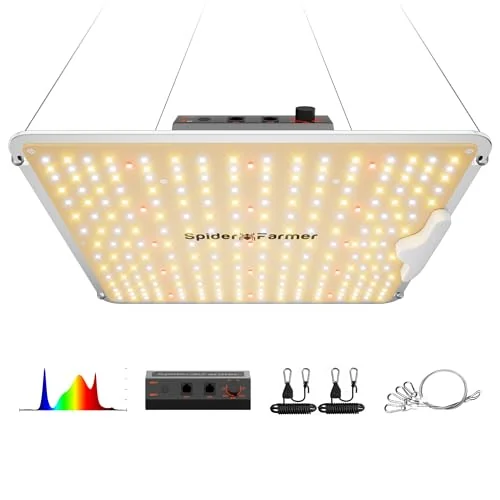
This is the all-round pick for a 2x2 ft tent or closet. Spider Farmer rates it at 100W of actual draw, with a 2x2 ft flowering footprint and 3x3 ft for vegetative growth. It lists 2.5 µmol/J efficacy, a measure of how much plant-usable light each watt produces, and a 5-year warranty. A dimming knob lets you turn it down for seedlings and up for flowering. Spider Farmer publishes these figures plainly, so you can compare it with the other panels here. The trade-offs: coverage stops at about 2x2 ft for flowering, and it has no built-in timer or app.

Best for
Beginners setting up one 2x2 ft tent who want a single dimmable light from seedling to harvest.
Skip it if
You only start seeds or grow herbs (the Barrina bars cost less), or you need to cover a 3x3 tent (the Mars Hydro FC-E3000 does).
  • Published PPFD coverage map
  • Dimmable driver for seedlings through flower
  • Runs cool and nearly silent with no fans
  • Only covers about 2x2 ft for flowering
  • No built-in timer or app control
Actual draw100W
Coverage2x2 ft flower, 3x3 ft veg
DimmingKnob, 0–100%
Warranty5 years
Efficacy2.5 µmol/J
Weight1.26 kg (net)
Spectrum2800–3000K, 4800–5000K, 660nm, 730nm

Sources

Research checked Nov 17, 2026. We research picks; we don't test them.
Pick 2
T5 Full Spectrum LED Grow Light Bars, 4-Pack

The seedling-shelf workhorse: linkable T5-style LED bars that mount under shelves, sip power, and cost less than a single panel — ideal for seed starting and herbs.

Picked for: Seed starting · Best value · Low running cost

✓ Very cheap to buy and to run✕ Not intense enough to flower fruiting plants
Our research on the Barrina T5 Full Spectrum LED Grow Light Bars, 4-Pack

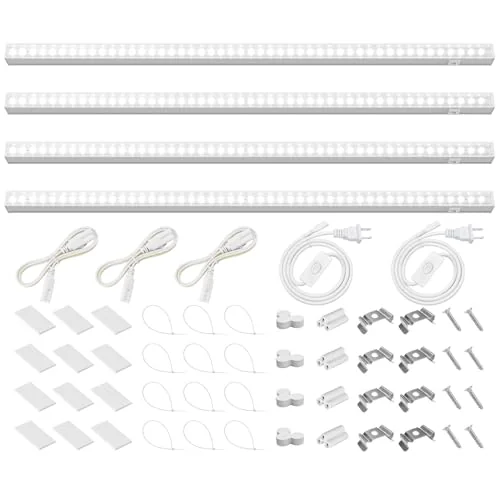
This is the seed-shelf pick. Instead of one panel, you get slim 2-ft bars that mount under shelves with the included clips, double-sided tape or cable ties. Barrina says the bars link end to end, up to 16 in a series. Each has its own on/off switch, so you can light only the shelves in use. Barrina rates its 2-ft T5 full-spectrum bars at 10W each, so a 4-pack costs little to run. The trade-offs: there is no dimming, and bars at this power are meant for seedlings, herbs and greens, not flowering fruiting plants.

Best for
Gardeners starting seeds or growing herbs and microgreens on a wire shelf who want low running costs.
Skip it if
You want to flower tomatoes, peppers or other fruiting plants. Choose a panel such as the Spider Farmer SF1000.
  • Very cheap to buy and to run
  • Bars link end-to-end and mount anywhere
  • Perfect intensity for seedlings and greens
  • Not intense enough to flower fruiting plants
  • No dimming control
Actual draw10W per 2-ft bar (40W per 4-pack)
Form factorLinkable T5-style bars
Best forSeed starting, herbs, microgreens
MountingClips, zip ties, or screws
Daisy chainUp to 16 bars
Beam angle120°
Spectrum5000K full spectrum

Sources

Research checked Nov 17, 2026. We research picks; we don't test them.
Pick 3
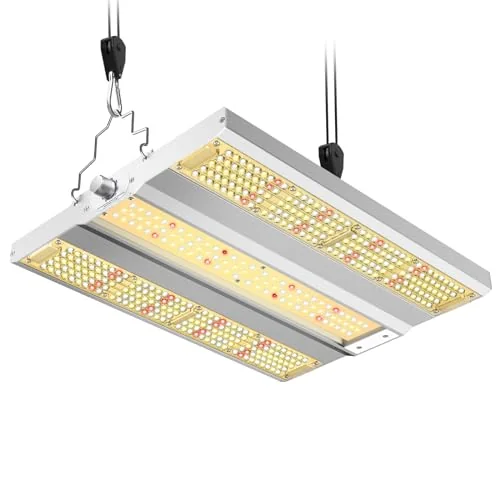
FC-E3000 LED Grow Light

A bar-style fixture that spreads roughly 300 real watts evenly across a 3x3 canopy — the step up when a single panel leaves your tent's corners dim.

Picked for: Full-cycle growing

✓ Even bar-style coverage across a 3x3 tent✕ Triple the running cost of a 100W panel
Our research on the Mars Hydro FC-E3000 LED Grow Light

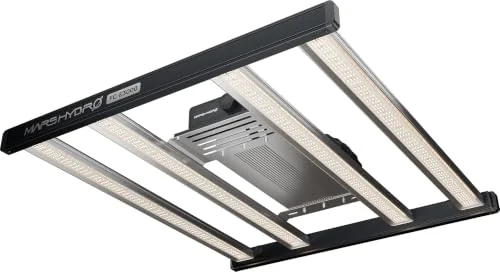
This is the step up for a bigger tent. The FC-E3000 spreads 300W across adjustable light bars instead of one board, which helps light reach the corners. The bar spacing can be changed to suit the plants. The listing gives Bridgelux chips, 2.8 µmol/J efficacy, 3x3 ft maximum coverage and a 2x2 ft core where light is strongest. A knob dims it from 10 to 100%, and up to 30 lights can be daisy-chained, meaning linked so one knob dims them all. The trade-offs: it draws three times the power of the 100W Spider Farmer and is far more light than seedlings or houseplants need.

Best for
Growers with a 3x3 ft tent and light-hungry flowering plants who want even coverage.
Skip it if
You grow in a 2x2 tent or only start seeds. The Spider Farmer SF1000 or Barrina bars cost less to buy and run.
  • Even bar-style coverage across a 3x3 tent
  • Dimmable, with up to 30 lights on one dimmer
  • Strong intensity for demanding flowering plants
  • Triple the running cost of a 100W panel
  • Overkill for seedlings and houseplants
Actual draw300W
Coverage3x3 ft max, 2x2 ft core (listing)
Form factor6-bar fixture
DimmingKnob, 10–100%
Efficacy2.8 µmol/J
Daisy chainUp to 30 lights
DiodesBridgelux

Sources

Research checked Nov 17, 2026. We research picks; we don't test them.

Pick 4
XS1500 Pro LED Grow Light

A close SF1000 rival with a lens-spread full spectrum and a dimmable driver at a frequently lower street price — worth cross-shopping whenever either goes on sale.

Picked for: Full-cycle growing · Best value

✓ Lens-spread full spectrum at an aggressive price✕ Slightly less even edge coverage than bar fixtures
Our research on the VIPARSPECTRA XS1500 Pro LED Grow Light

This is the main cross-shop against the Spider Farmer SF1000 for a 2x2 ft tent. VIPARSPECTRA lists a 150W draw, 3x3 ft for vegetative growth and 2x2 ft for flowering. The spectrum mixes 3000K and 5000K white with 660nm red and 730nm far-red, meant to carry plants from seed to flower. A built-in dimmer adjusts output, and VIPARSPECTRA says its optical lenses spread light evenly to the corners. Up to 20 lights can be daisy-chained for shared dimming. The trade-off: it draws about 50% more power than the SF1000 for the same 2x2 flowering footprint.

Best for
Buyers outfitting a 2x2 tent or closet who want to compare prices with the SF1000 and buy whichever is cheaper.
Skip it if
Running cost matters most. The 100W Spider Farmer SF1000 covers the same 2x2 flowering area on less power.
  • Lens-spread full spectrum at an aggressive price
  • Dimmable for seedling-to-flower use
  • Compact fit for 2x2 tents and closets
  • Slightly less even edge coverage than bar fixtures
  • Brand support is thinner than Spider Farmer's
Actual draw150W
Coverage2x2 ft flower, 3x3 ft veg
DimmingKnob, 0–100%
Daisy chainUp to 20 lights
Spectrum3000K, 5000K, 660nm, 730nm IR

Sources

Research checked Nov 17, 2026. We research picks; we don't test them.

Pick 5
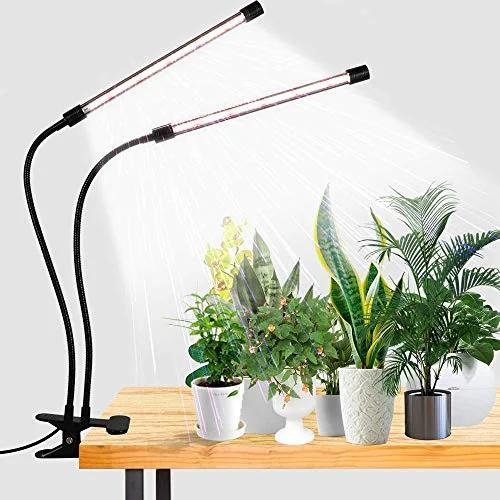
6000K Clip-On Gooseneck Grow Light

A clip-on gooseneck lamp for a few houseplants or a windowsill herb pot — gentle white light with a timer, not a growing system, and priced accordingly.

Picked for: Seed starting · Low running cost · Best value

✓ Built-in timer and flexible goosenecks✕ Too weak for fruiting or flowering plants
Our research on the GooingTop 6000K Clip-On Gooseneck Grow Light

This is the houseplant and windowsill pick, not a growing system. It clamps onto a shelf, desk or windowsill, and its two flexible goosenecks aim light at a couple of pots. It gives off white 6000K light that looks normal in a living room, and a built-in timer cycles it off after 4, 8 or 12 hours. At about 10W it costs very little to run. The trade-offs are clear: it is too weak to flower or fruit plants, and it covers only a pot or two.

Best for
Apartment dwellers giving a few houseplants or a herb pot extra light without changing how the room looks.
Skip it if
You are starting trays of seedlings (choose the Barrina bars) or growing fruiting plants (choose a panel like the Spider Farmer SF1000).
  • Built-in timer and flexible goosenecks
  • Pleasant white light that suits living spaces
  • Clips to shelves, desks, and windowsills
  • Too weak for fruiting or flowering plants
  • Small coverage — a couple of pots at most
Actual drawAbout 10W
Color6000K white
Timer4/8/12-hour cycles
MountClamp with dual goosenecks

No maker or retailer spec page found, so these details come from the Amazon listing. Research checked Nov 17, 2026.

Comparison of every grow lights pick
Pick
Spider Farmer SF1000 LED Grow Light#1
Mid-rangeSpider Farmer SF1000 LED Grow Light
Barrina T5 Full Spectrum LED Grow Light Bars, 4-Pack#2
BudgetBarrina T5 Full Spectrum LED Grow Light Bars, 4-Pack
Mars Hydro FC-E3000 LED Grow Light#3
PremiumMars Hydro FC-E3000 LED Grow Light
VIPARSPECTRA XS1500 Pro LED Grow Light#4
Mid-rangeVIPARSPECTRA XS1500 Pro LED Grow Light
GooingTop 6000K Clip-On Gooseneck Grow Light#5
BudgetGooingTop 6000K Clip-On Gooseneck Grow Light
Price & buy

$69.99

Check price on Amazon

$43.99

Check price on Amazon

$169.99

Check price on Amazon

$99.99

Check price on Amazon

$21.99

Check price on Amazon

Prices checked Oct 10, 2026 and change often. Specs are as the manufacturers state them. We may earn a commission from qualifying Amazon purchases.

How to choose grow lights

Ignore the wattage in the product name

A light sold as "1000W" often draws 100 real watts — the name refers loosely to old HID equivalence. The honest numbers are actual power draw and a PPFD map showing light intensity across the footprint. Reputable brands publish both; treat any listing that hides them as a red flag.

Match the form factor to the job

Quantum-board panels suit grow tents and single plants. Bar-style fixtures spread light more evenly over wide canopies and run cooler. Clip and T5 strip lights are for seedlings and herbs on shelves — cheap and low-power, but not intense enough to flower fruiting plants.

Count the running cost

A light running 14 hours a day is a permanent line on your power bill. A true 100-watt panel costs a few dollars a month at average US rates; a 300-watt fixture triples that. Dimmable drivers let you run seedlings at low power and ramp up only when plants demand it.

Common questions

Why does a "1000W" grow light only draw 100 watts?

The number in the name is marketing shorthand for claimed HID-equivalent output, not power draw. What matters is actual wattage from the wall and the PPFD map — the measured light intensity across the coverage area. Honest brands publish both in the listing.

Can I start seedlings with a cheap shop-style LED?

Yes — seedlings need far less intensity than flowering plants. Linked T5-style LED bars a few inches above the tray work well and cost little to run. You only need a real panel once plants move toward fruiting or flowering stages.

How much does a grow light add to my electric bill?

Multiply actual wattage by daily hours and your utility rate. A true 100-watt panel on a 14-hour schedule uses roughly 42 kWh a month — a few dollars at typical US rates. Timers and dimmable drivers keep that number from creeping.

More in Indoor Growing