How Far Should Grow Lights Be From Seedlings? Setup Guide
6 min readPublished Primer Path Level 5
Researched and written by the GardenPrimer editorial team · How we research
The quick answer
There is no single correct height, because distance depends on how powerful the fixture is. As starting points: small clip lights sit two to six inches away, T5-style bars four to eight inches, and full panels twelve to twenty-four inches. Then adjust based on how the seedlings actually respond.
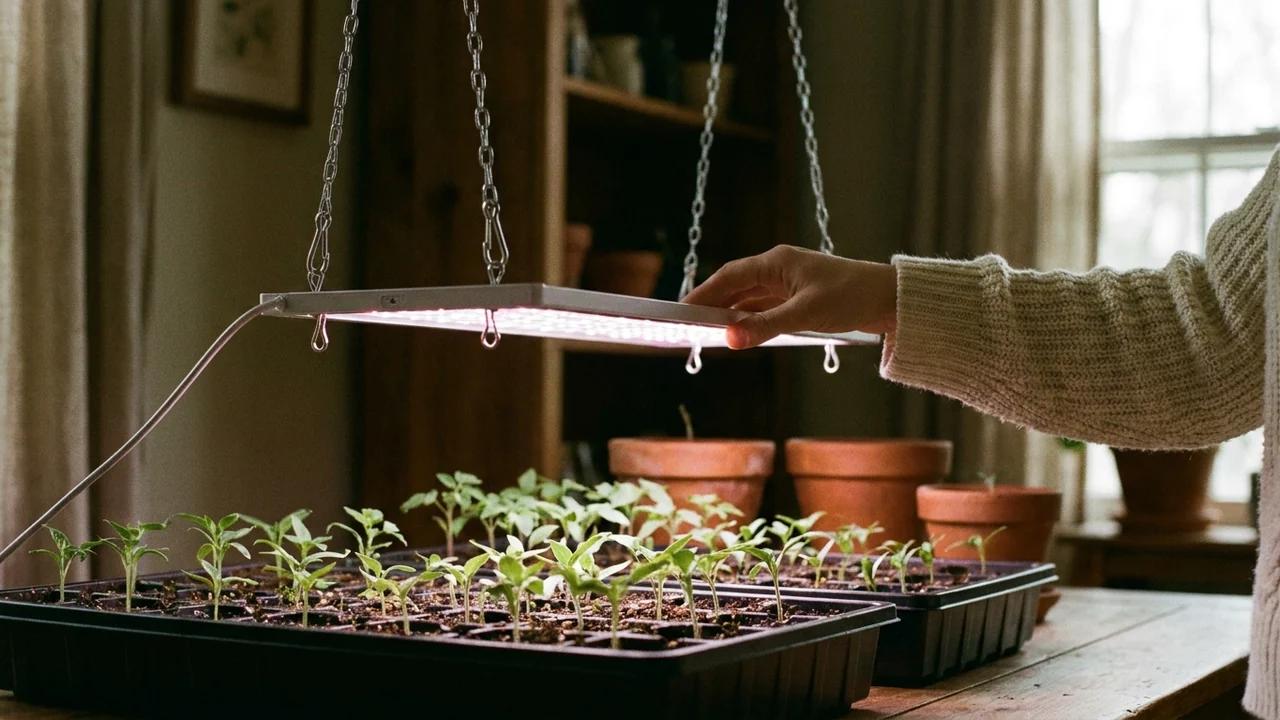
Search this question and you will get answers ranging from two inches to two feet, all stated with total confidence. They are not contradicting each other so much as describing different equipment. Distance is not really the variable that matters; light intensity reaching the leaves is, and intensity is a product of the fixture's output and how far away it hangs. A cheap clip lamp and a full-size panel need completely different heights to deliver the same thing.
Start from the fixture, not from a rule
Any grow light height you read online is meaningless without the fixture attached to it. Before anything else, find your model's manual or product page and look for a recommended hanging height for seedlings or the vegetative stage. That number beats every general guideline, including this article's.
When the manual is missing or vague, the table below gives reasonable starting points. Treat them as an opening position, not a setting.
| Fixture type | Typical draw | Starting distance above seedlings | Notes |
|---|---|---|---|
| Clip-on LED or single bulb | Roughly 10 to 30 watts | 2 to 6 inches | Intensity falls off fast; covers one small pot, not a tray |
| T5-style fluorescent or LED bar | Roughly 20 to 60 watts | 4 to 8 inches | The classic seed starting setup; runs cool enough to sit close |
| Multi-bar or blade-style LED | Roughly 60 to 150 watts | 8 to 18 inches | Good even coverage over one or two 1020 trays |
| Full LED panel or quantum board | 150 watts and up | 12 to 24 inches | Designed for mature plants; often needs dimming for seedlings |
| All-in-one smart garden | Built in, fixed | Fixed by design | Height is preset by the manufacturer, so follow their guidance |
If you are still choosing hardware, the practical differences between these formats are laid out in the grow lights category, and sealed countertop units are covered separately under indoor smart gardens.
The hand test
The oldest check in the book still works, and it costs nothing:
- Turn the light on and let it run for at least fifteen minutes so it reaches operating temperature.
- Hold the back of your hand at the height of the seedling tops, directly under the brightest part of the fixture.
- Leave it there for thirty seconds.
- If you feel noticeable warmth building, the light is too close. Raise it an inch or two and test again.
- If it feels neutral, the height is safe from a heat standpoint.
The hand test only rules out heat damage. It says nothing about whether the light is bright enough, which is why you still have to read the plants.
What the seedlings are telling you
Seedlings are unusually honest reporters. Give a new height about five to seven days, then look at the growth that appeared during that window.
| What you see | Most likely cause | What to do |
|---|---|---|
| Long thin stems, wide gaps between leaves, plants leaning | Light too far away or too few hours | Lower the fixture 2 to 4 inches and extend the schedule |
| Pale washed-out or whitish patches on the top leaves | Light too close, bleaching the tissue | Raise 4 to 6 inches, or dim the fixture if it supports it |
| Leaf edges curling up and inward, taco shaped | Too close, usually heat plus intensity together | Raise the fixture and improve airflow across the tray |
| Crisp dry leaf tips on the tallest plants | Tall seedlings have grown into the hot zone | Raise the light and consider potting up |
| Short thick stems, deep green, tight leaf spacing | Correct height | Change nothing; raise as they grow |
Leggy seedlings do not un-stretch. New growth can come in tight once you fix the light, but the elongated section stays. For tomatoes you can bury the stretched stem at transplant time, which is one reason they forgive early mistakes better than most crops. Timing that transplant is covered in when to plant tomatoes.
Hours matter as much as inches
Raising and lowering a fixture is only half the equation. Total daily light exposure is the other half, and it is the easier one to get right.
- Run seedlings 14 to 16 hours a day for most vegetables and flowers.
- Put the fixture on a cheap mechanical or smart timer. Consistency beats attentiveness.
- Do not run lights 24 hours. Plants do real work in the dark period, and some crops respond badly to no night at all.
- A sunny south window is not a substitute in late winter. Window light is both dimmer and directional, which is why windowsill seedlings lean.
- If plants are stretching despite a correct height, add hours before you drop the fixture further.
Raising the light as they grow
The fixture height that was right on day three is wrong by day fourteen, because the plants moved and the light did not.
- Check the gap between the tallest leaves and the fixture twice a week.
- Maintain your target distance from the top of the canopy, not from the soil surface.
- Use an adjustable hanging system with ratchet hangers or a chain; fixed shelf mounts force awkward workarounds.
- When one seedling towers over the rest, move it to its own spot rather than raising the light for everyone.
- Keep the light where it is right after transplanting into larger cells, since the canopy just dropped relative to the fixture.
About PPFD, honestly
You will run into PPFD in product listings and forum arguments. It stands for photosynthetic photon flux density, and it measures how many photons in the range plants actually use land on a given area each second. It is the right unit for the job, because it describes what reaches the leaf rather than what the fixture consumes at the wall.
Two caveats keep it from being useful advice here:
- Real values depend on the exact fixture, its dimming level, the distance, and the reflectivity of the space. Any number quoted without all four is decoration.
- Measuring it properly takes a quantum sensor, which costs more than most seed starting setups.
So treat PPFD as a way to compare two fixtures using the manufacturer's own published charts, and use plant response for day-to-day decisions. If a listing publishes a PPFD map at several heights, that is a genuinely good sign about the manufacturer.
Where this fits on the Primer Path
Grow lights belong to four-season gardening, the level where you start producing your own transplants instead of buying them in May. Pair this with watering seedlings, since leggy growth and damping off usually show up together, and with the tray and dome choices in seed starting kits. The same fixture earns its keep year round for growing herbs indoors in winter, and the planting calendar will tell you when to switch it on for spring.
Common questions
Why do articles give such different grow light heights?+
Because they are describing different fixtures. A 12-watt clip lamp and a 200-watt panel deliver wildly different light intensity, so the same distance means something different for each. Any height recommendation is only useful alongside the fixture type and wattage it was written for.
How many hours a day should grow lights run for seedlings?+
Fourteen to sixteen hours a day suits most vegetable and flower seedlings, on a timer so it is consistent. Plants use the dark period for real metabolic work, so running lights around the clock is not better and can stress some crops.
Are my seedlings leggy because the light is too far away?+
Usually yes, though two other causes stack on top of it: too few hours per day, and too much heat or humidity from a dome left on after germination. Fix the height first, then the schedule, then the dome, and check new growth over the following week.
Do I need to measure PPFD to start seeds successfully?+
No. PPFD is a useful number for growers optimizing yield, but seedlings are forgiving. Start at your fixture manual's recommended hanging height, watch stem thickness and leaf color for a week, and adjust. Plant response is a reliable guide at this scale.