Watering Seedlings: How to Do It Without Killing Them
6 min readPublished Primer Path Level 5
Researched and written by the GardenPrimer editorial team · How we research
The quick answer
Water seedlings from below: set the cell tray in a half inch of water for ten to twenty minutes, then pour off what is left. Let the surface dry between waterings. Most seedling deaths come from a constantly wet soil surface, not from thirst.
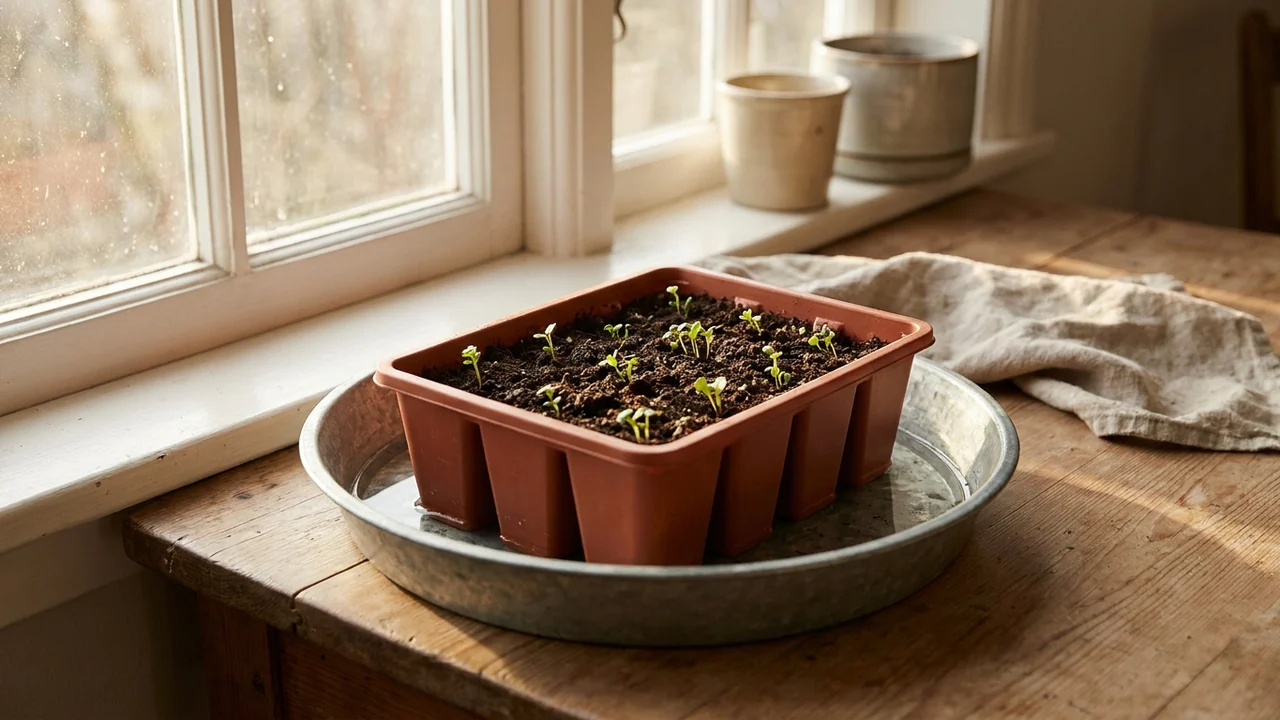
Most seedlings that die on a windowsill did not die of thirst. They drowned, rotted through at the soil line, or got flattened by an enthusiastic watering can. Water is the variable a first-time seed starter controls most and understands least, so here is the short version: water from below, water less often than feels right, and let the surface dry between drinks.
Bottom watering is the default
Bottom watering means setting your cell tray into a solid outer tray holding a shallow layer of water and letting the mix pull moisture up through the drainage holes. It should be your normal method, for four reasons:
- The surface stays dry. Damping off, the fungal collapse that topples seedlings at the soil line, needs a persistently wet surface. Bottom watering denies it that.
- Roots chase the water down. Moisture concentrated at the bottom of the cell pulls roots downward instead of letting them loiter near the top.
- Nothing gets knocked over. A stream from a can is a small flood at seedling scale.
- It self-limits. The mix absorbs roughly what it can hold and stops, which is far more forgiving than guessing with a spout.
If a cell has dried into a brick, it may float rather than absorb. Peat and coir both turn water-repellent when fully dry. Break the tension with one gentle top watering, wait ten minutes, then go back to bottom watering.
How to bottom-water, step by step
- Pour about half an inch of room temperature water into the solid outer tray.
- Set the cell tray inside so the drainage holes sit in the water.
- Wait ten to twenty minutes. Deep cells and dense mixes take longer.
- Watch the surface. When the top of the mix darkens, the cell has wicked all the way up.
- Lift the cell tray out and dump whatever water is left. Do not let cells sit in standing water past about thirty minutes.
That lifting step is where cheap trays betray you. A flimsy 1020 tray full of wet mix flexes and dumps. Sturdier options like Bootstrap Farmer trays are why experienced starters stop replacing gear every February, so read through the seed starting kits category before committing to a system.
The damping off connection
Damping off is not one organism. It is a group of soil fungi present almost everywhere that only turn destructive when conditions favor them. Those conditions are boringly consistent:
- A soil surface that never dries
- Cool temperatures paired with high humidity
- Stagnant air with no movement across the tray
- Crowded cells with overlapping leaves
- Reused trays and pots that were never washed
Fix the watering and you have fixed most of it. Add a small fan on low a few hours a day, thin to one seedling per cell, and pull the dome once germination is done. This is the most common way a promising tray fails, which is why it leads our roundup of seed starting mistakes.
Misting versus watering
A spray bottle is a comfort object more than a tool. Misting deposits water on the surface and essentially none in the root zone, which is precisely the moisture profile that invites fungal trouble.
Misting has exactly two legitimate jobs:
- Keeping the surface from crusting over before seeds have sprouted, when no humidity dome is in use
- Raising humidity briefly around newly uncovered seedlings on a very dry indoor day
Once cotyledons are up, put the bottle away and water the tray properly.
Dome on, cracked, off
Humidity domes solve germination and then quietly cause problems if you leave them on out of habit.
| Stage | Dome position | Why |
|---|---|---|
| Sown, not sprouted | On, fully closed | Holds surface moisture so seeds do not dry mid-germination |
| First sprouts breaking through | Cracked or vented | Drops humidity and starts air exchange before fungi settle in |
| Most cells sprouted | Off during the day, on at night if the room is dry | Transition period; the surface should now dry between waterings |
| True leaves showing | Off for good | Seedlings need airflow, light, and a drying cycle far more than humidity |
A dome left on after germination is the fastest route to leggy, floppy seedlings. Weak stems usually trace back to two causes at once: too much humidity and lights too far away. Our guide to grow light distance for seedlings covers the second half of that pair.
How often to water, by stage
Check by weight, not by calendar. Lift the tray each morning: light means water, heavy means wait. The table below is what that habit usually produces.
| Stage | Typical interval | What you are aiming for |
|---|---|---|
| Sown to germination | Rarely, if a dome is on | Evenly damp all the way through, never soggy |
| Cotyledons only | Every 2 to 4 days | Top quarter inch dries between waterings |
| First true leaves | Every 2 to 3 days | Full wick each time, then drain completely |
| Potted up or nearly transplant size | Daily to every other day | Roots fill the cell and drink fast |
| Hardening off outdoors | Often twice a day | Wind and sun dry small cells surprisingly quickly |
Warmer rooms, a heat mat like the VIVOSUN models, and stronger lights all shorten these intervals. Shallow cells dry faster than deep ones.
Reading the seedling
Over and under watering can look alike at a glance. The details separate them.
| Sign | Overwatered | Underwatered |
|---|---|---|
| Wilting | Limp with wet soil, does not recover after watering | Crisp collapse that rebounds within an hour of water |
| Leaf color | Pale, yellowing from the bottom up | Dull, edges drying and turning papery |
| Soil surface | Green algae or white fuzz | Pulled away from the cell walls, pale and dusty |
| Stem base | Dark, thin, water-soaked pinch point | Normal color, plant simply flags |
| Growth | Stalled with no new leaves | Slowed, resumes quickly once watered |
That dark pinch at the stem base is damping off, and it does not reverse. Remove the affected cell, improve airflow, and protect the rest of the tray.
Small details that matter
- Use room temperature water. Cold water chills the root zone and stalls growth for a day or more.
- Wash trays and domes between seasons with hot soapy water.
- Skip fertilizer until true leaves appear, then feed at quarter strength and follow the label.
- Never let a tray sit in a saucer of standing water overnight.
Where this fits on the Primer Path
Seed starting is a four-season skill, the level where you stop buying transplants and start producing them. It builds on the outdoor watering judgment you develop in how often to water a vegetable garden, and it pays off directly at transplant time, which the planting calendar will time for you against your local frost dates. If you are earlier on the path, start with a single tray of one easy crop and get the watering rhythm right before scaling up.
Common questions
How often should I water seedlings?+
There is no fixed schedule. Check daily by lifting the tray: a light tray needs water, a heavy one does not. In practice that lands around every two to four days early on, and closer to daily once true leaves and a full root system arrive.
Is bottom watering always better than top watering?+
For seedlings, yes, as your default. Top watering is fine for the very first soak when you fill and settle the mix, and for rewetting a cell that has dried so hard it will not wick. After germination, bottom watering keeps the soil surface dry and roots growing downward.
Can I just mist my seedlings instead?+
No. Misting wets the surface and almost nothing below it, which is the exact condition damping off fungi want. Misting has a narrow job: keeping the very top of the mix from crusting before seeds sprout, and only when a humidity dome is not doing that work already.
Should I use tap water for seedlings?+
Room temperature tap water is fine for nearly everyone. Cold water straight from the tap chills the root zone and slows growth, so fill your container and let it sit a few hours. If your water is heavily softened with salt, use filtered or collected rainwater instead.