How Often to Water a Vegetable Garden: A Simple Guide
5 min readPublished Primer Path Level 3
Researched and written by the GardenPrimer editorial team · How we research
The quick answer
Most established in-ground vegetable gardens want about one inch of water per week, delivered in one or two deep soakings rather than daily sips. Raised beds usually need it every two to three days in summer, and containers often daily. Check the soil two inches down before every watering.
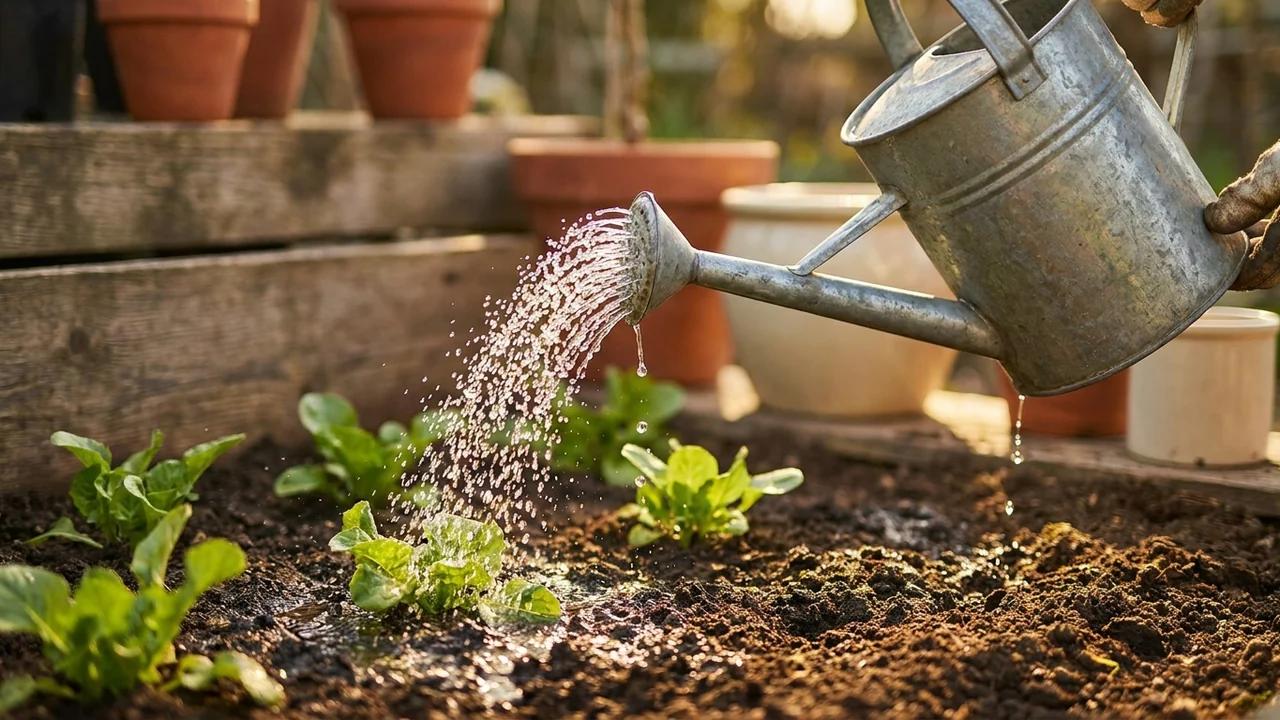
Watering is where most first-year vegetable gardens go wrong, and it is almost never because someone forgot. It is because the water arrived in small, frequent sips that never reached the root zone. The honest answer to "how often" is that frequency is the wrong dial to start with. Volume comes first, timing second, and the plant and the soil will tell you the rest if you know where to look.
Start with the principle: deep and rare
A shallow daily splash keeps the top inch damp and teaches roots to stay there, where they cook in the first heat wave. A long, slow soak pushes moisture six to eight inches down and pulls roots after it.
Aim for roughly one inch of water per week for an established in-ground vegetable garden, delivered in one or two soakings rather than seven light ones. In real heat, that number goes up.
A few habits that make "deep and rare" actually work:
- Water in the early morning so leaves dry before evening and less is lost to midday evaporation.
- Water the soil, not the plant. Overhead sprinklers on tomatoes and squash invite leaf disease.
- Mulch two to three inches deep. Mulch is the cheapest irrigation upgrade there is.
- Set an empty tuna can under the sprinkler or emitter to see how long an inch actually takes.
The finger test beats any schedule
Before you water anything, push a finger into the soil up to the second knuckle, in the root zone rather than at the edge of the bed.
| What you feel | What to do |
|---|---|
| Dry and crumbly at 2 inches | Water deeply now |
| Cool and slightly damp at 2 inches | Wait a day, check again |
| Wet and sticky at 2 inches | Skip; check for drainage problems |
| Dry surface, damp underneath | Skip. That crust is normal |
Do this for two weeks and you will stop needing it. You will have learned what your soil looks like when it is thirsty.
Containers and beds are not on the same clock
The container on your porch and the bed in your yard have completely different water budgets, and treating them the same is the fastest way to lose one of them.
| Growing situation | Warm-season frequency | Why |
|---|---|---|
| Small pots, under 5 gallons | Daily, sometimes twice | Tiny soil volume, exposed sides |
| Large containers and grow bags | Every 1 to 2 days | More reservoir, still exposed |
| Raised beds, 10 to 12 inches deep | Every 2 to 3 days | Drains fast, warms early |
| Deep raised beds and in-ground | Every 4 to 7 days | Large moisture reserve |
| Seedlings and transplants, any site | Lightly, most days | Roots are still in the top inch |
Raised beds sit in moving air on all sides, so they dry faster than the same soil in the ground. That is the trade for the drainage and the early spring warmth, and it is worth knowing before you build. If you are still weighing the two, raised bed versus in-ground walks through the whole comparison, and the raised garden beds category covers depth, which matters more for watering than any other spec.
Adjust for weather, soil, and growth stage
Frequency is a starting point that conditions push around. Use this to nudge, not to calculate.
| Condition | Adjustment |
|---|---|
| Sustained heat above 90F, windy | Increase by roughly half |
| Cool and overcast | Cut back; check before watering |
| Sandy soil | Same weekly volume, split more often |
| Heavy clay | Same volume, less often, slower |
| Just transplanted | More often, smaller amounts |
| Flowering and fruiting | Most critical stage; keep it even |
| Ripening tomatoes and melons | Ease off slightly for flavor |
Even moisture matters more than total moisture for fruit quality. Swinging between bone dry and soaked is what splits tomatoes and gives squash blossom-end rot.
Reading the plant: too much or too little
Wilting is the confusing one, because both problems cause it. Check the soil before you reach for the hose.
| Signal | Underwatered | Overwatered |
|---|---|---|
| Soil at 2 inches | Dry | Wet, possibly sour smelling |
| Leaf edges | Crispy, brown, curling up | Soft, yellowing, limp |
| Yellowing pattern | Older outer leaves first | Lower leaves, spreading up |
| Afternoon wilt | Recovers overnight | Stays wilted next morning |
| Growth | Stalls, leaves small | Stalls, stems may darken at base |
Midday wilt on squash and cucumbers in full sun is often normal. If the plant is upright again by morning and the soil is damp, do nothing.
Make it repeatable
The gardens that stay watered in August are the ones where watering stopped depending on a human remembering. Two upgrades, in order:
- Put a timer on the spigot. Even a simple mechanical one turns a decision into a default. Start in garden hoses and timers.
- Move from spraying to dripping. Drip puts water at the root zone with almost nothing lost to wind or evaporation, and it keeps foliage dry. Our drip irrigation kits picks cover the small kits that suit a bed or two, and drip irrigation for raised beds is the step-by-step setup.
If you want a broader look at efficient watering products and practices, the EPA's WaterSense program is a useful public resource hub on the topic.
Where this fits on the Primer Path
Watering by feel rather than by calendar is a Level 3 skill. It is the habit that separates a garden that limps to August from one that is still producing, and it is exactly what The Steady Garden is built around: consistent moisture, mulch, and a schedule that survives a vacation. If you are earlier than that, how to start a vegetable garden covers the setup decisions first, and you can see all five levels on the Primer Path.
Common questions
Is it better to water in the morning or evening?+
Morning is better. Leaves dry quickly once the sun is up, which lowers disease pressure, and less water is lost to evaporation than at midday. Evening watering is a workable second choice, but wet foliage overnight can encourage fungal problems on tomatoes and squash.
My plants wilt every afternoon. Am I underwatering?+
Not necessarily. Large-leafed plants like squash and cucumbers often wilt in intense afternoon sun and recover on their own overnight. Check the soil two inches down instead. If it is damp and the plant is upright by morning, the wilt was heat, not thirst.
How much is one inch of water in practice?+
Set a straight-sided container such as an empty tuna can in the watering zone and run your sprinkler or hose until it fills to one inch. Time that once and you will know your setup's rate, which turns watering into a timer setting rather than a guess.
Do I still need to water after it rains?+
Check before assuming. A brief shower often wets only the top half inch, especially where mulch or a leaf canopy intercepts it. Push a finger into the root zone after the rain. If it is dry at two inches, water as normal.