Growing Herbs Indoors in Winter: What Actually Works
5 min readPublished Primer Path Level 5
Researched and written by the GardenPrimer editorial team · How we research
The quick answer
Chives, mint, parsley and thyme handle winter indoors reliably; basil and cilantro need much stronger light, and rosemary and dill rarely cooperate. The limiting factor is light, so add an LED on a timer for 12 to 16 hours a day, water only when the top inch is dry, and harvest a third at a time.
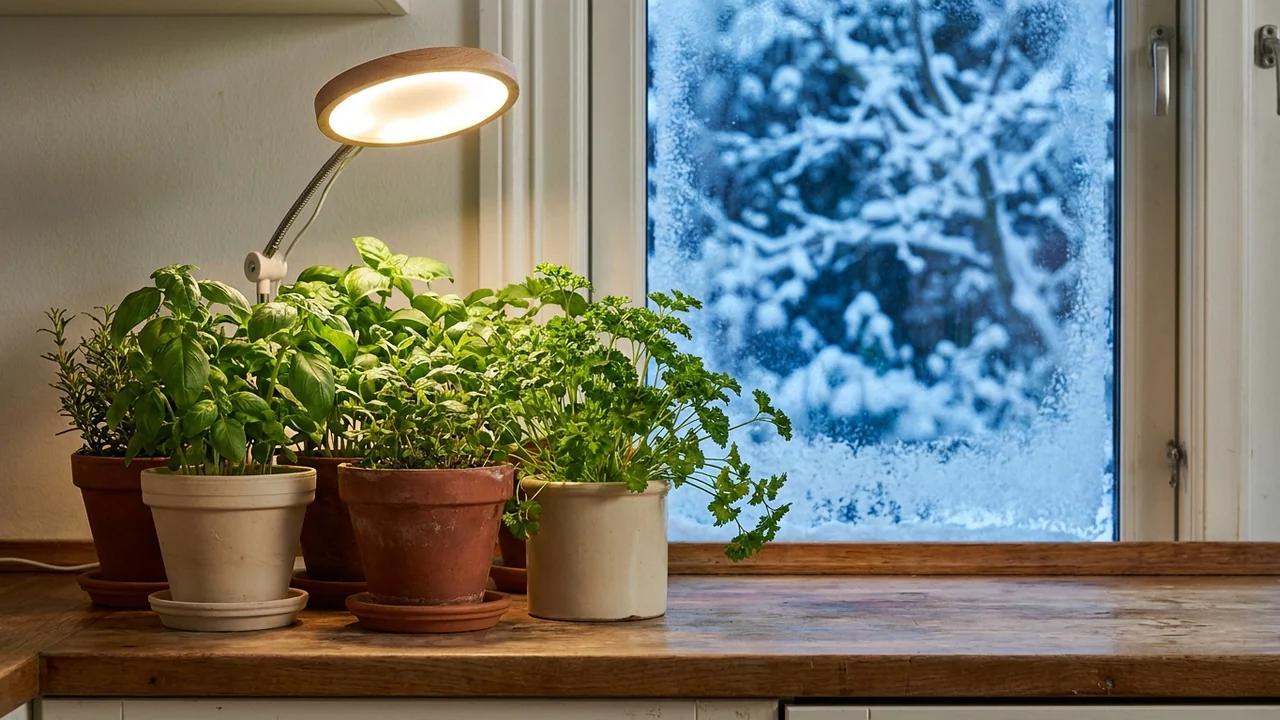
Windowsill herb gardens have a reputation for dying by February, and the reason is almost never neglect. It is light. Herbs indoors in winter are working with a fraction of the energy they had in July, and the plants that survive that trade are a specific, fairly short list. Pick from that list, give them real light, and change how you water and harvest, and an indoor herb setup can genuinely carry a kitchen from November to spring.
Which herbs actually work indoors
Some herbs tolerate low light and dry indoor air. Others sulk no matter what you do, or need more room than a countertop offers.
| Herb | Indoors in winter | Why |
|---|---|---|
| Chives | Excellent | Shallow roots, regrows fast after cutting |
| Mint | Excellent | Vigorous and forgiving; keep it in its own pot |
| Parsley | Very good | Slow to start, then steady all winter |
| Thyme | Good | Wants the brightest spot and dry-ish soil |
| Oregano | Good | Similar to thyme; trim often to stay compact |
| Basil | Good with strong light | Fails fastest on a windowsill; loves warmth |
| Cilantro | Fair | Bolts quickly; resow every 3-4 weeks |
| Rosemary | Difficult | Wants cool nights, bright light, and hates wet feet |
| Dill, fennel | Difficult | Tall taproots, poor fit for small containers |
Start with chives, mint, parsley and thyme. They are the four that reward a beginner setup, and three of them are perennials that will still be going next winter.
The light reality
This is the whole game. A bright south window in midwinter delivers a small fraction of summer outdoor light, at a low angle, for a short day. Herbs respond by stretching pale and thin, which is the same failure covered in seed starting mistakes.
| Setup | Realistic result | Cost and effort |
|---|---|---|
| South-facing window only | Chives and mint survive; basil goes leggy | Free, no equipment |
| Window plus a small LED | Everything on the list does well | Low, one fixture and a timer |
| Dedicated grow light shelf | Strongest growth, largest harvests | Moderate, needs shelf space |
| Countertop smart garden | Reliable and hands-off, limited plant count | Highest per plant, ongoing pods |
The practical middle is a clip-on or shelf LED over an existing window, run on an outlet timer. Aim for 12 to 16 hours a day, with the fixture close enough that leaves are clearly lit but not warm to the touch, and give the plants a dark period. Options are scored at grow lights.
The pod-cost consideration for smart gardens
Countertop smart gardens are genuinely good at this. They handle light, timing and watering, and they sidestep the two hardest parts of indoor growing. The catch is the economics, and it is worth doing the arithmetic before you buy.
- Most systems use proprietary seed pods that cost far more per plant than a seed packet.
- A pod is single use; the sponge and shell get discarded after each grow.
- Many models also want branded nutrient solution on a schedule.
- Refill costs recur for as long as you own the machine, unlike a light you buy once.
Several systems sell blank or refillable pods that take your own seeds. If you are drawn to a smart garden, check whether the model you want supports them before you buy. It is the difference between a cheap ongoing habit and an expensive one. Our picks are at indoor smart gardens.
Watering indoors is a different job
Indoor winter conditions are dry air and slow growth at the same time, which is a confusing combination. The air pulls moisture off leaves and soil surfaces while the plant itself is using very little water. Most indoor herbs die wet, not dry.
- Water when the top inch of mix is dry to the touch, never on a fixed day of the week.
- Every pot needs a drainage hole. A decorative cachepot with no drainage is the most common killer.
- Water until it runs out the bottom, then empty the saucer within 30 minutes.
- Group pots together or set them on a pebble tray to raise local humidity.
- Keep them off cold glass overnight and away from a heat vent blowing directly on them.
The same principle applies outside, where the rule is to read the soil rather than the calendar; see how often to water a vegetable garden.
Harvest rhythm keeps plants alive
Indoor herbs decline when they are ignored, not when they are cut. Regular harvesting keeps growth compact and triggers new branching, and a plant nobody touches gets tall, woody and thin.
- Wait for size. Let a new plant reach 6 inches or so before the first real cut.
- Take a third at most from any plant in one go.
- Cut above a leaf pair. On basil, mint and oregano, two new shoots emerge from that junction.
- Never pull single leaves off basil. Take whole stem tips instead; leaf-picking makes a bare stalk.
- Pinch flower buds off as soon as you see them. Flowering stops leaf production and turns the flavor bitter.
- Cut chives at the base, an inch above the soil, rather than trimming the tips flat.
Expect a slower rhythm than summer. A winter basil plant might support one good harvest every two to three weeks, and pushing harder than that thins the plant faster than it can recover.
Where this fits on the Primer Path
Growing indoors in winter belongs to four-season gardening, the level about extending the year rather than starting it. It also doubles as practice for spring, since the light, watering and airflow habits are the same ones that produce good transplants. If you are still building your first outdoor beds, how to start a vegetable garden is the better starting point, and a windowsill of chives and parsley is a fine thing to keep going alongside it.
Common questions
Which herbs are easiest to grow indoors in winter?+
Chives, mint, parsley and thyme. All four tolerate lower light and dry indoor air, and three are perennials that carry over to the following winter. Basil is worth growing too, but only if you can give it a dedicated light rather than a window.
Can herbs survive on a south-facing window alone?+
Some can. Chives and mint usually hang on, and thyme may manage in the brightest spot you have. Basil and cilantro almost always stretch pale and thin. A small LED fixture on an outlet timer above the window sill fixes it inexpensively.
Are countertop smart gardens worth it?+
They are reliable and genuinely hands-off, which is their appeal. The cost sits in proprietary seed pods and branded nutrients that recur for as long as you own the unit. Check whether your model accepts refillable or blank pods before buying.
How often should I harvest indoor herbs?+
Regularly, but lightly. Take no more than a third of a plant at once, cut above a leaf pair so two new shoots form, and pinch off any flower buds. In winter expect roughly one good harvest every two to three weeks per plant.