How to Get Rid of Aphids on Plants: The Gentle Ladder
5 min readPublished Primer Path Level 4
Researched and written by the GardenPrimer editorial team · How we research
The quick answer
Start with a firm blast of water on the undersides of leaves, repeated every two or three days. If that fails after three rounds, prune the worst tips, then spot-treat with insecticidal soap and follow the label. Skip spraying entirely when ladybug larvae or tan aphid mummies are present.
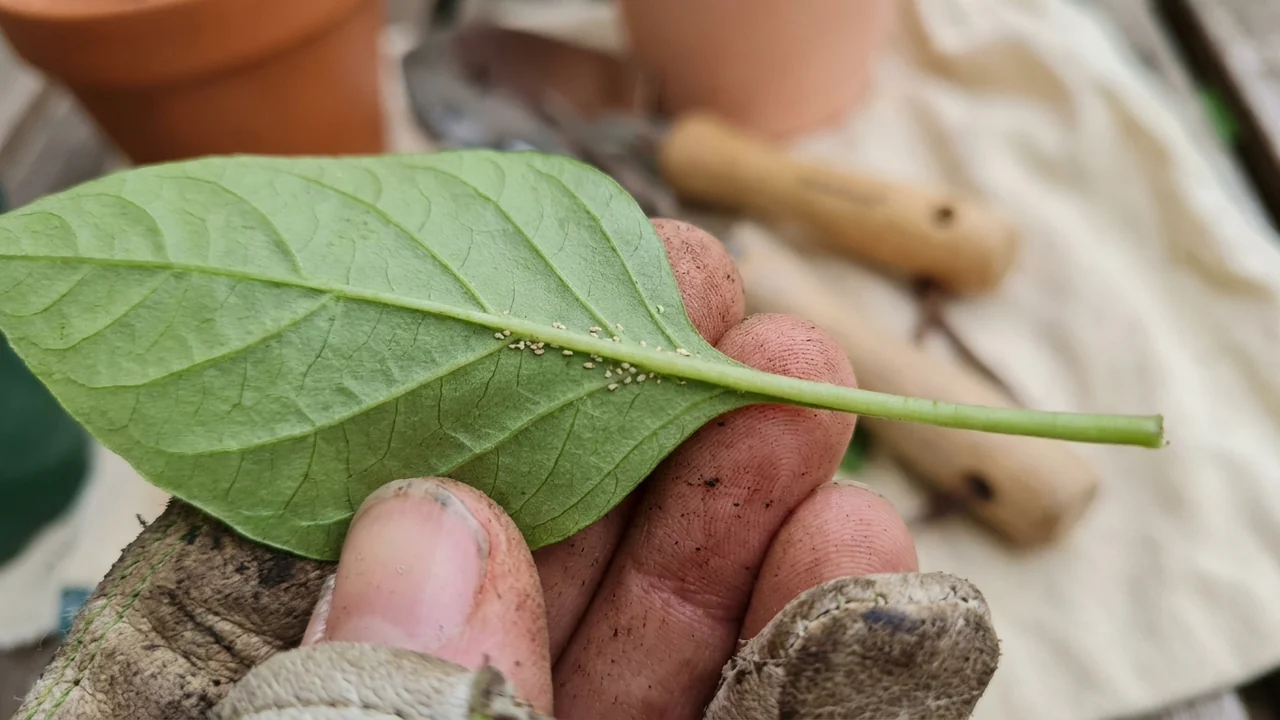
Aphids are the first pest most new gardeners meet, and they always arrive with terrible timing: on the softest new growth, right when a plant is putting on its spring push. They are also, genuinely, one of the easier problems in the garden to solve. The trick is to work up a ladder rather than reaching for the strongest bottle in the shed on day one, because the strongest bottle usually kills the insects that were about to solve the problem for you for free.
First, confirm it really is aphids
Aphids are smaller than a sesame seed, pear-shaped, and soft-bodied. Look for several of these signs together, not just one:
- Where they cluster. The undersides of new leaves, the last few inches of a growing tip, and unopened flower buds. Older, tougher leaves are usually clean.
- Color tells you nothing. They come in green, black, gray, pink, pale yellow, and dusty white. Shape and location are the reliable clues.
- Two little tailpipes. Aphids carry a pair of tube-shaped cornicles standing up off the rear end. Nothing else you will meet on a tomato has them.
- Sticky leaves below the colony. That shine is honeydew, which is aphid waste. If a leaf feels tacky, something sap-sucking is above it.
- A sooty black film. A dark mold grows on honeydew. It is cosmetic, but it is a flag.
- White flecks that never move. Shed skins. They mean the colony has been there a while.
Stippled, dusty-dry leaves with fine webbing and no stickiness point to spider mites instead. Cupped, twisted new growth with no insect visible at all is often herbicide drift from a neighbor's lawn treatment, and no spray will fix that.
Start with water, every single time
A firm blast from a hose wand knocks aphids off, and most never make it back. They are slow, and they do not fly until winged forms appear late in an infestation. This one step resolves a surprising share of outbreaks on its own.
- Support the stem with one hand so you do not snap it.
- Aim at the undersides of leaves, where the colony actually lives.
- Repeat every two or three days for a week. One pass rarely does it; three usually does.
- Water in the morning so foliage dries before evening.
If you are fighting your equipment more than the aphids, a wand that makes a real jet is worth more than any product on the shelf. Our scored picks live at /category/garden-hoses-timers.
The escalation ladder
Work down this table only as far as you need to. Most gardens stop at row two.
| Step | What it is | Move here when | Cost to beneficials |
|---|---|---|---|
| 1 | Water blast plus finger-squishing dense colonies | Any time you see aphids | None |
| 2 | Prune out the two or three worst tips and bag them | The colony is concentrated on a few shoots | None |
| 3 | Insecticidal soap, undersides only, spot-treated | Water has failed after three rounds | Low, but kills soft-bodied larvae it wets |
| 4 | Horticultural oil or neem, spot-treated | Repeated soap sprays are not holding | Moderate; smothers eggs and larvae too |
| 5 | Stop and reassess the plant | Nothing is holding by midseason | The plant may be the problem, not the pest |
Soap and oil work by contact only. Nothing happens to an aphid you did not physically wet, and there is no residual protection tomorrow, which is why coverage of leaf undersides matters more than concentration. Mix and apply exactly as the label states, including the plants listed as sensitive, and follow the label for temperature and re-application limits. Products carrying an OMRI listing are catalogued at the OMRI Lists resource hub if you are gardening to organic standards. Our scored options sit at /category/pest-disease-control.
When NOT to spray. Do not spray if the aphid bodies look bloated, tan, and papery, or if you see ladybug larvae (tiny alligator-shaped bugs with orange spots) or lacewing larvae on the plant. Bloated tan aphids are mummies, meaning parasitic wasps have already taken over the colony from the inside. Do not spray open flowers, do not spray above roughly 90 degrees or in direct midday sun, and do not spray a wilted plant. Waiting three days at that point beats spraying almost every time.
The ants are part of the problem
If a steady line of ants runs up the stem, they are not attacking the aphids. They are farming them, drinking the honeydew and actively driving off the ladybugs and lacewings that would otherwise clear the colony.
- Break the ant highway with a sticky band on the trunk of woody plants.
- Clear mulch, weeds, and leaves so no bridge touches the stem from the side.
- Deal with the aphids at the same time; removing the ants alone just slows the farm down.
Build a garden that fights back
Beneficial insects arrive on their own if there is something for the adults to eat. Buying ladybugs by the tub mostly funds a short flight to a neighbor's yard.
- Let a few cilantro, dill, or fennel plants bolt into flower and leave them standing.
- Plant small-flowered natives and umbels, such as yarrow and sweet alyssum, along bed edges.
- Skip broad-spectrum sprays entirely; they cost you the predators for weeks.
- Tolerate a low, steady aphid population. A garden with zero aphids supports zero aphid-eaters.
Prevention beats treatment
Aphids concentrate on lush, soft, fast-pushed growth, which means over-fertilizing with nitrogen quietly manufactures the problem. If the first number on the bag is high and you are applying often, ease off; /blog/npk-numbers-explained walks through why, and steadier options are scored at /category/organic-fertilizers.
| Habit | Why it helps |
|---|---|
| Scout new growth twice a week | Ten aphids are a two-minute job; a thousand is a weekend |
| Feed moderately, not heavily | Soft nitrogen-forced shoots are aphid food |
| Water consistently | Stressed plants attract and hold pests longer |
| Rinse plants before bringing them indoors | Indoor colonies have no predators at all |
| Buy plants inspected, not just pretty | Most outbreaks arrive on a nursery pot |
Indoor and overwintering plants deserve extra scrutiny, since nothing eats aphids in your living room. That applies to anything you keep going under lights, as covered in /blog/growing-herbs-indoors-in-winter.
Where this fits on the Primer Path
Pest response belongs to /path/feed-and-defend, the level where you learn to read a plant and answer proportionally instead of reactively. If you are earlier in the sequence, the habits that prevent most aphid outbreaks, mainly consistent water and restrained feeding, are built in /path/steady-garden. And if you are still setting up your first beds, start at /blog/how-to-start-a-vegetable-garden and let the pest chapter wait until something actually shows up.
Common questions
Does dish soap work on aphids?+
Household dish detergent is a degreaser, not an insecticidal soap, and it strips the waxy coating from leaves. It can burn foliage badly in sun or heat. Use a product actually labeled as insecticidal soap and mix it at the rate the label states.
Will aphids kill my plant?+
Rarely on an established plant. Heavy colonies stunt and distort new growth, coat leaves in sticky honeydew, and can spread plant viruses. Seedlings and indoor plants are the real casualties, because they have less reserve and no resident predators.
Should I buy ladybugs to release?+
Usually not worth it. Purchased ladybugs typically disperse within a day or two rather than staying to work your plants. Growing small-flowered plants like alyssum, dill, and yarrow attracts and keeps local predators far more reliably, and it costs almost nothing.
How often should I reapply soap or neem?+
Only as often as the product label allows, and only on plants that still have live aphids. These sprays kill on contact with no lasting residue, so results come from thorough coverage of leaf undersides rather than from spraying more frequently than the label permits.