Robot Mower vs Cordless Mower: Which Fits Your Yard?
5 min readUpdated
Researched and written by the GardenPrimer editorial team · How we research
The quick answer
Choose a robot mower if you want mowing to stop being a weekly task and your yard is reasonably open — expect setup work and ongoing blade costs. Choose a cordless mower if your lawn is small, your budget is tight, or you want control over cut height, edges and timing.
Our top-scored picks for this decision
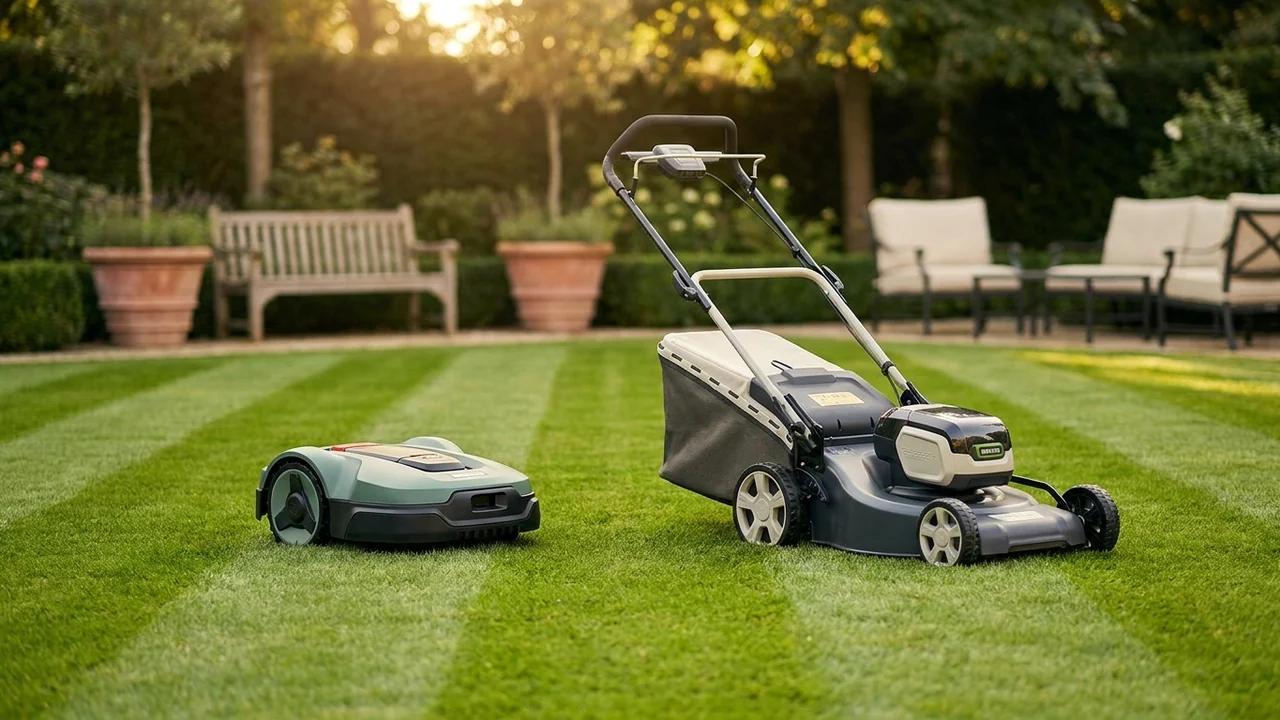
Two machines, two philosophies. A robot mower is a standing arrangement with a lawn you stop thinking about; a cordless mower is a tool you pick up once a week and put down forty minutes later. Both cut grass well, and neither is a gimmick anymore. The honest question is not which one is better — it is which trade you would rather live with: more money and setup work up front, or more of your Saturday, every week, for as long as you own the yard.
The picks at a glance
| Mower | Type | Price band | Best for | Verdict |
|---|---|---|---|---|
| Segway Navimow i210 AWD | Robot, wire-free | Mid | Tidy lawns up to roughly a quarter acre | The simplest way into hands-off mowing |
| Segway Navimow i105N | Robot, wire-free | Entry | Small lawns up to about 1/8 acre | The cheapest robot we rank, with no wire to lay |
| Mammotion Luba 2 AWD | Robot, wire-free, all-wheel drive | Premium | Large, sloped or multi-zone yards | The one that climbs what others refuse |
| Ego Power+ 21" self-propelled | Cordless push | Mid | Most suburban lawns | The default answer if mowing doesn't bother you |
| Greenworks 40V 21" self-propelled | Cordless push | Entry to mid | Households that want batteries included | Best value if you are starting from nothing |
Price bands are relative, not quotes — robot mowers in particular swing hard around sales. Current scores and pricing live on the robot mower and cordless mower category pages.
What the sticker price leaves out
A cordless mower is a purchase. A robot mower is closer to an appliance that lives outdoors and runs a hundred-plus times a season.
Budget for these before you decide:
- Robot blades. Most robots use small razor-style blades designed to be swapped several times a season. Individually cheap, easy to forget, and a dull set is why a robot starts leaving ragged tips.
- Boundary wire. Wire-guided robot mowers need a perimeter wire pegged around the lawn. That is an afternoon of work — and a repair job the first time an edger finds it.
- Winter storage. In freezing climates the robot and its dock come indoors, and the battery wants a partial charge rather than an empty one. Follow the manual.
- Battery replacement. Every battery machine eventually needs a fresh pack. Assume it happens once during the mower's working life, on both sides of this comparison.
- Cordless extras. A second battery is close to mandatory above a small lot, plus a sharpened or replaced blade each spring.
Neither category is expensive to run. But a robot's costs are thin and continuous while a cordless mower's are lumpy and obvious, which is exactly why robots tend to feel cheaper than they are.
Match the machine to the yard
Yard shape decides this more often than budget does.
| Your yard | The complication | Lean toward |
|---|---|---|
| Small, one open rectangle | None | Either — cordless if you don't mind mowing |
| Small, with beds, paths and trees | Lots of edges and no-go zones | Wire-free robot, or cordless |
| Quarter to half acre, gentle slopes | Run time and coverage | Wire-free robot, or cordless with two batteries |
| Steep banks and terraces | Traction | All-wheel-drive robot, or a mower you steer yourself |
| Front and back split by a driveway | Two separate zones | Cordless, unless the robot handles multiple zones |
| Heavy leaf drop or constant sticks | Obstacles the robot can't judge | Cordless |
Two things no robot does well: the first shaggy cut of spring, and grass that got away from you during a rainy week. Both want a machine with a person behind it.
Effort versus control
Robots trade control for consistency. Cordless mowers trade consistency for control.
- Robots mow little and often, leaving clippings short enough to vanish into the turf. The result reads as uniformly decent rather than freshly striped.
- Robots do not edge. You still own a string trimmer and you still walk the perimeter.
- Cordless mowers give you height on demand — raise the deck through August heat, drop it before overseeding, bag when you need to.
- Cordless mowers are quiet enough for an early start, which is the underrated argument for leaving gas behind.
- Robots need a tidy lawn to work. Dog toys, hose ends and fallen branches get picked up before every run, not after.
The lawn is also the least interesting part of most yards. If mowing is the chore blocking you from the beds, handing it off buys back real time — the same logic behind drip irrigation for raised beds, where automation removes a recurring task instead of performing it better than you would.
Setup: an afternoon versus five minutes
- Wire-free robots are configured by walking the perimeter once, then drawing no-go zones around beds in the app. Satellite or vision positioning wants a reasonably open view of the sky, so heavy tree cover is a real constraint.
- Wire-guided robots need the boundary wire pegged down before the first cut. It disappears into the turf within a few weeks, but the install is the honest price of admission.
- Cordless mowers need a charged battery and a clear deck. That is the whole setup.
Who should pick which
- Small simple lawn, tight budget → cordless. At the entry price a cordless mower outperforms every robot in its bracket, and there is nothing to install.
- You dislike mowing more than you dislike setup → robot. One afternoon of configuration replaces every mow for years.
- Steep, terraced or awkward ground → all-wheel-drive robot, or stay manual. Standard robots slip and strand on grades that a self-propelled push mower walks.
- Crisp stripes and sharp edges matter to you → cordless. Robots deliver tidy, not sharp.
- You travel through the growing season → robot. Coming home to a mowed lawn is the whole pitch.
- You would rather be growing food than grass → robot. Time reclaimed from the lawn is time for the beds, which is the same instinct behind starting a vegetable garden in the first place.
Where this fits on the Primer Path
Mower choice is a Steady Garden decision — it shows up once your beds are established and the maintenance load, not the enthusiasm, is what limits you. If you are earlier than that, spend the money on the growing space instead and work through the Primer Path in order; a good watering habit, covered in how often to water a vegetable garden, pays back faster than any mower will.
Common questions
Do robot mowers actually work on hills?+
Standard robot mowers handle gentle grades and slip on steep ones. All-wheel-drive models like the Mammotion Luba 2 are built for banks and terraces. If most of your lawn is sloped, treat all-wheel drive as a requirement rather than an upgrade.
Do I still need a string trimmer with a robot mower?+
Yes. No consumer robot mows cleanly against fences, walls or bed edges, and no-go zones leave a margin of uncut grass. Plan on walking the perimeter with a trimmer every couple of weeks to keep the lawn looking finished.
Is a robot mower cheaper than a cordless mower over time?+
Usually not on money, often yes on time. Robots cost more up front and add blades, winter storage and an eventual battery. What they actually buy is the removal of a weekly chore, which is the fair way to judge the trade.
Can a robot mower handle grass that got tall while I was away?+
Poorly. Robots are designed to trim a little every day, so overgrown grass bogs them down or trips their safety cutouts. Make one manual pass at a higher cut height first, then let the robot resume its normal schedule.