Electric Snow Shovel vs Snow Blower: Choose by the Job
6 min readPublished Primer Path Level 5
Researched and written by the GardenPrimer editorial team · How we research
The quick answer
Choose an electric snow shovel for small areas and light snow. Choose a single-stage blower for a paved driveway, and consider two-stage for repeated deep or heavy snow. Match the exact machine to snow type, discharge space, and surface; an intake-height rating alone is not a performance promise.
Our top-scored picks for this decision
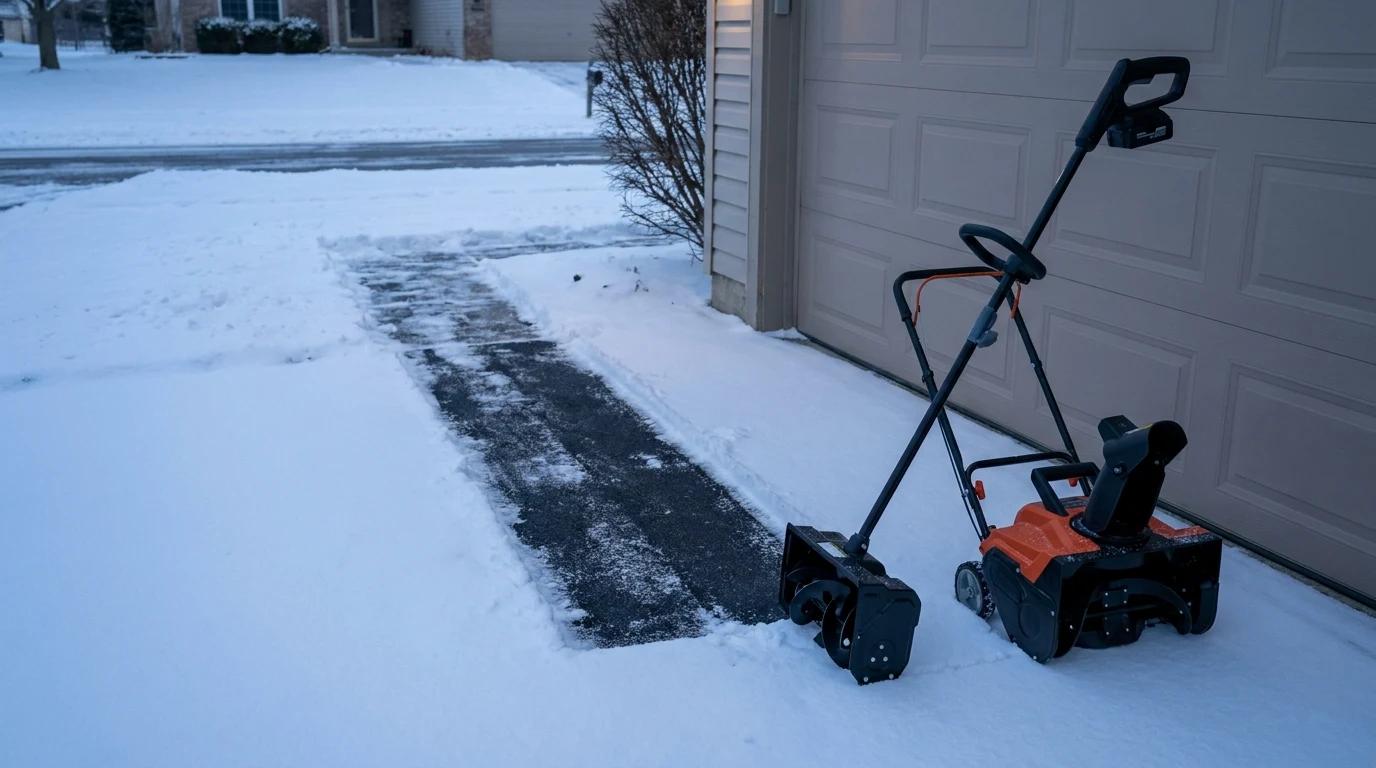
A powered shovel makes sense when the job is a deck, a few steps, or a short walk. A driveway changes the calculation: clearing width, discharge control, and the snow left by the street plow matter more than whether the machine uses a battery.
These four catalog options cover the useful choices. Dimensions below are manufacturer ratings, not results from our own testing.
| Product | Best for | Spec that matters | Trade-off |
|---|---|---|---|
| Snow Joe 24V-SS13 kit | Steps, decks, short walks | 13-inch width; 6-inch cut per pass | Narrow path; deeper snow needs repeated layers |
| Snow Joe SJ627E | Flat paved areas near an outlet | 22-inch width; 13-inch intake | Extension-cord routing limits the job |
| EGO SNT2122 kit | Driveways where a cord is awkward | 21-inch width; two 4.0Ah batteries | Finite battery capacity; manual push operation |
| Honda HSS928 tracked | Large paved areas and deeper snow | 28-inch width; 21.7-inch intake | Gas upkeep and bulky storage; no gravel use |
Three questions before choosing a machine
Measure the area you actually clear, including the route to bins and the mailbox. Then consider the ordinary snowfall and its texture. A shallow wet layer and a tall fluffy drift are different jobs.
Ariens' heavy-snow guidance favors single-stage machines for lighter snowfall and two-stage designs for heavy, wet snow. The matrix translates that broad advice and the specifications above into a starting point.
| Typical snowfall | Area to clear | Starting choice | What changes the answer |
|---|---|---|---|
| Light, loose snow within a 6-inch cut | Deck, steps, short sidewalk | Cordless shovel | Repeated layers become tedious on a larger area |
| Light to moderate snow | Flat paved driveway with reachable outlet | Corded single-stage blower | Cord route crosses the clearing path or cannot reach |
| Light to moderate snow | Paved driveway without a convenient outlet | Battery single-stage blower | Check kit battery size and recharge plan |
| Repeated deep or heavy, wet accumulation | Large paved driveway | Two-stage blower | Intake size alone does not guarantee easy clearing |
| Plow-packed entrance | Any driveway size | Examine the exact model's packed-snow claims | A short driveway can still have a difficult entrance |
💡 Buy for the bottleneck. A tiny path may need only a powered shovel; a short driveway with a dense plow ridge may justify a bigger machine.
The electric shovel's six-inch limit is per pass
The Snow Joe 24V-SS13 kit is a targeted cleanup tool. Its operator's manual describes clearing deeper drifts in layers of up to six inches with a sweeping motion. So six inches is not an absolute storm cutoff. It is the maximum cut in one pass.
That distinction prevents two bad purchases: dismissing a shovel for occasional deeper snow, or expecting it to clear a whole deep driveway conveniently. More layers mean more work, and the 13-inch path requires more overlapping swaths than a wider blower.
- Choose it for small spaces you can clear without repeatedly moving snow twice.
- Check where the discharge will land before buying; the manual describes changing direction by angling the tool.
- Keep an ordinary shovel or scraper for finish work rather than expecting a powered rotor to solve every patch.
A wide intake is not a snow-quality rating
A 13-inch intake describes the opening. It does not promise full-width clearing through every 13-inch snowfall. Snow density, pace, and the amount fed into the auger also matter; Ariens recommends overlapping passes and adjusting speed in heavy conditions.
Avoid the opposite blanket rule, too: single-stage does not automatically mean incapable of plow snow. EGO's current platform page expressly describes a steel auger for packed snow and plow banks. It lists the EGO SNT2122 kit with two 4.0Ah batteries, while its headline driveway-capacity claim uses two 6.0Ah batteries. Those are different kits.
⚠️ Match every runtime or driveway-size claim to the included batteries. Do not transfer the larger kit's capacity figure to a smaller kit with the same blower body.
Battery or cord: choose the constraint you can manage
A cordless machine removes the extension-cord route, but the battery remains a planning constraint. The shovel manual instructs users to store its battery and charger at room temperature away from moisture. Use the charging limits in your particular manual; a cold garage is not automatically a suitable charging location.
Before committing to a battery system:
- Confirm the exact battery and charger in the kit.
- Decide where you can store and charge them correctly.
- Plan what happens if a charge ends before the clearing job does.
For the Snow Joe SJ627E, the manual's cord chart requires 14 AWG up to 50 feet and 12 AWG above 50 through 100 feet; it prohibits longer cords. It also calls for GFCI protection and an outdoor-rated cord.
- Start near the outlet and work outward, as the manual directs.
- Keep the cord away from the moving auger and inspect it for damage.
- Check the route before buying: electrical reach and workable reach are different things.
Two-stage does not mean suitable for every surface
The Honda HSS928 tracked machine adds a wider intake and powered drive. Those features suit a different scale of job from carrying a shovel around a patio. They also bring engine maintenance and a larger storage footprint.
But tracks are not permission to clear gravel. The Honda manual explicitly prohibits gravel roads and driveways because stones can be ejected. Check the exact machine's manual rather than applying a generic rule about two-stage blowers.
Before the first clearing pass
- Remove visible stones, wire, sticks, and other loose objects.
- Keep people out of the discharge area.
- Never reach into an auger or chute to clear a blockage.
- Shut down and isolate power as the manual directs, then use the specified clearing tool. For the Honda, that means stopping the engine, disconnecting the spark-plug cap, and using its clearing bar.
Those steps come from the linked Honda manual; the electrical and battery machines have their own shutdown instructions.
Compare the complete snow-blower catalog after deciding the job. Existing batteries can affect ownership cost, but compatibility needs checking by platform and model—the same principle discussed in robot mower vs cordless mower.
Common questions
Can an electric snow shovel clear more than six inches of snow?+
The featured shovel manual permits deeper drifts to be removed in layers of up to six inches per pass. That can work for a small area, but it adds repeated passes. Treat the per-pass cut and the whole clearing job as separate questions.
Is every single-stage blower unsuitable for a plow ridge?+
No. Some manufacturers explicitly describe packed-snow and plow-bank capability for particular models. Read that exact model’s specifications and instructions rather than judging every machine by its stage count.
Can I use the tracked Honda in this guide on a gravel driveway?+
No. Its operator’s manual prohibits clearing gravel roads and driveways because the machine can throw stones. Tracks and a two-stage design do not override that instruction.